
Editor’s Note: Kratt Nation, a discussion paper by an Estonian working group of specialists from Nortal, the University of Tartu, Swedbank and Estonia’s Ministry of Justice and Digital Affairs, plus an independent expert, argues that an AI agent’s limits must be enforced by the systems that receive its actions rather than written into the agent’s instructions. Nortal’s website dates the paper Nov. 4, 2026. It proposes four conditions, including that agents not be given a person’s authentication or signing credentials, and four action classes that scale an agent’s independence to how serious and reversible each step is. The authors say the proposals have not yet been validated as a national model. At the separate Tallinn Digital Summit, held Nov. 5 and 6 in Tallinn, Prime Minister Kristen Michal said Estonia is drafting rules for AI agents.
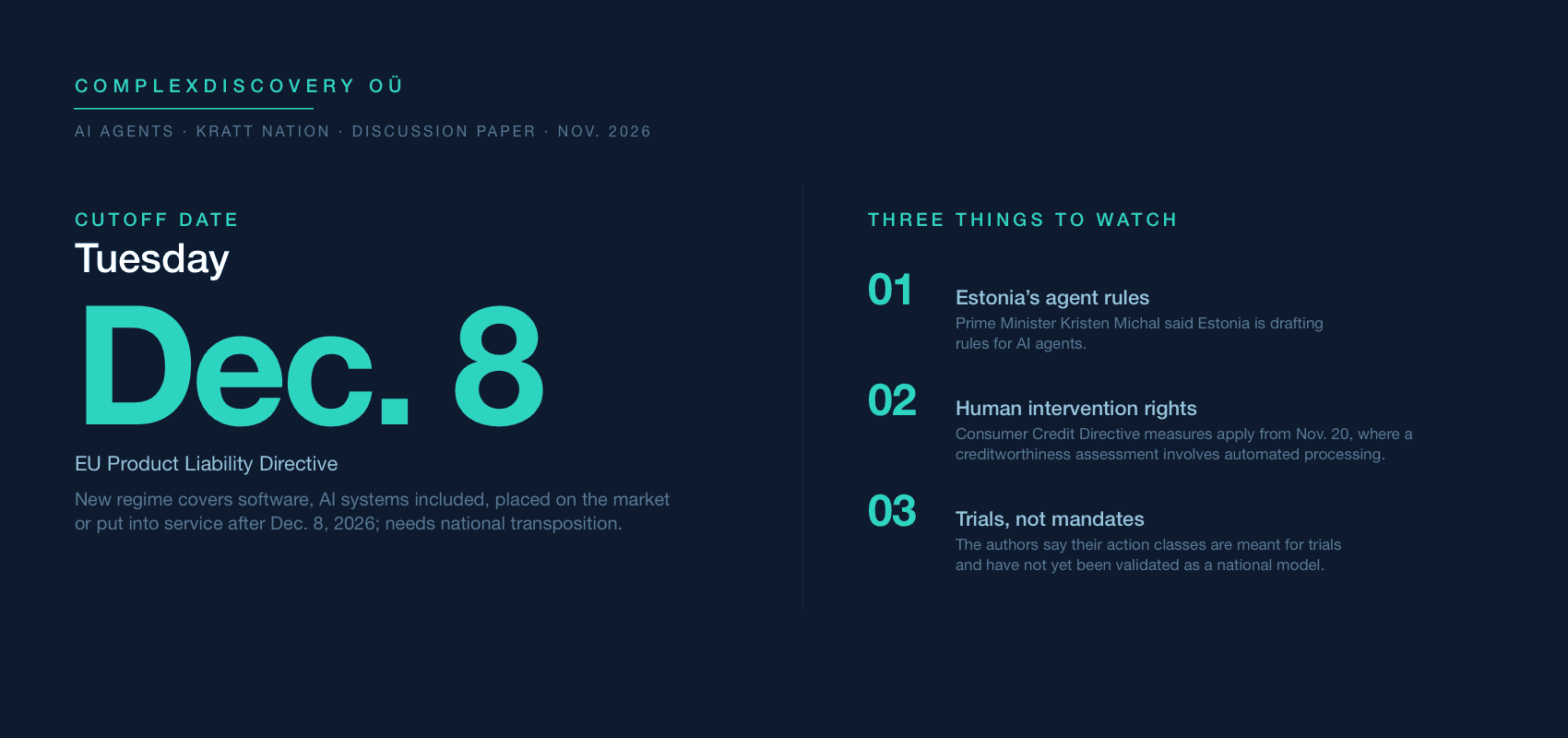
For cybersecurity, information governance and eDiscovery professionals, the paper’s sharpest point concerns evidence: a log shows which channel an action came through but cannot prove who operated the software. Watch Estonia’s draft agent rules and the EU’s revised Product Liability Directive, whose new regime covers products placed on the market or put into service after Dec. 8, 2026.
Disclosure: ComplexDiscovery attended the 2026 Tallinn Digital Summit, its third consecutive year covering the event. ComplexDiscovery OÜ is a private limited company registered in Estonia, and two ComplexDiscovery staff members are e-residents of Estonia. Nortal, which hosts the paper, is listed among the summit’s strategic partners.
Content Assessment: Kratt Nation paper puts the AI agent's leash in the receiving system
Information - 94%
Insight - 95%
Relevance - 93%
Objectivity - 93%
Authority - 94%
94%
Excellent
A short percentage-based assessment of the qualitative benefit expressed as a percentage of positive reception of the recent article from ComplexDiscovery OÜ titled, "Kratt Nation paper puts the AI agent's leash in the receiving system."
Industry News – Artificial Intelligence Beat
Kratt Nation paper puts the AI agent’s leash in the receiving system
ComplexDiscovery Staff
The ninth Tallinn Digital Summit opened Nov. 5 with an Estonian folk tale about the kratt, a servant cobbled together from household junk that labors tirelessly so long as someone gives it orders. The narrator advised handing it a job with no end, like braiding a rope from sand, and added a condition, ComplexDiscovery reported from the hall: “But always keep one end in your own hand.”
Separately, a discussion paper from an Estonian working group of officials, academics and industry specialists applies the same folk lesson to a set of proposed controls. Titled “Kratt Nation,” it appears on the website of the digital services firm Nortal, whose insights index dates it Nov. 4, 2026. The paper argues that an AI agent’s limits belong in the system that receives its actions, not in the instructions the agent is given. For cybersecurity, information governance and eDiscovery professionals, that choice decides what can later be proven about an agent: who authorized an action, what the agent was allowed to do and what the log can and cannot establish.
What the Kratt Nation working group proposes
The paper, subtitled “Dividing work between people, AI agents and rules,” grew out of what its authors call “voluntary collaboration between government, academia and the private sector.” The Estonian Centre of Excellence in Artificial Intelligence supported its preparation. Its authors include Andres Raieste, Nortal’s global head of public sector; Mihkel Solvak, an associate professor of technology research at the University of Tartu; Toomas Vaks, a cyber risk manager at Swedbank; and independent expert Madis Tapupere. Tõnu Grünberg also served on the group; the paper lists him as deputy secretary general for digital infrastructure and cybersecurity at Estonia’s Ministry of Justice and Digital Affairs. A chief data and AI officer from that ministry and Nortal’s chief government technology officer complete the roster.
The authors aimed it chiefly at policymakers and the people running public services, with enough depth for the lawyers and technologists who advise them, and they concentrate on government administration plus regulated sectors such as banking, telecommunications and utilities. From that base they propose four conditions for using AI agents. No agent may be given a person’s authentication or signing credentials, and the organization on the receiving end, not the agent, must enforce the agent’s limits. Every service needs channel and continuity targets suited to its purpose and to the law, and essential services must stay reachable in practice if the agents go down. Anything the law or an organization’s own policy reserves for a human stays with a human, and the people affected need a workable way to contest the outcome.
The authors are candid about the paper’s standing. The four conditions are requirements it advocates, its legal examples are EU or Estonian ones that need checking against local law, and the same legal duties will not hold in every jurisdiction. Its suggested action classes and coverage measures are meant for trials in real services and “have not yet been validated as a national model,” the authors write.
Why a prompt is a sign and not a lock
The paper’s most quotable line is also its most practical. “A notice on a door is not a lock,” the authors write. A prompt telling an agent not to pay over 50 euros only shapes its behavior, while a payment-system check that rejects anything above 50 euros enforces the boundary even if the agent has misread its job. Agents also ingest web pages and files that may contain text posing as instructions, and the paper, citing OWASP’s guidance on prompt injection, says organizations should not count on a model always refusing such text.
The authors do not oversell the lock. Staying inside a limit does not make an action right, they write, because an agent can settle the wrong invoice while holding a valid authorization. It can also make a string of allowed payments that add up to something nobody wanted. Caps on cumulative value or on the number of actions blunt that second danger, while the first still calls for checking the action against the evidence behind it.
Credentials are the second front. An agent driving a person’s browser through a logged-in session can be hard to tell apart from the person, so the paper prefers a dedicated agent interface where the person authorizes specific actions inside the organization’s own system. It names the Model Context Protocol as one implementation option. It also cites read-only agent interfaces at banks including LHV in Estonia, whose beta, as the paper describes it, issues a one-hour access token and a 30-day refresh token revocable through internet banking.
Security teams will recognize the fraud vector the authors flag next. A person can be tricked into authorizing an attacker’s agent, and a genuine confirmation screen does not stop a deceived person from consenting. The paper suggests narrow default permissions, alerts sent by a route the agent cannot reach, a waiting period before broader powers apply and quick revocation, while warning that revoking access does not reverse actions already taken.
Four classes of autonomy and the samples behind them
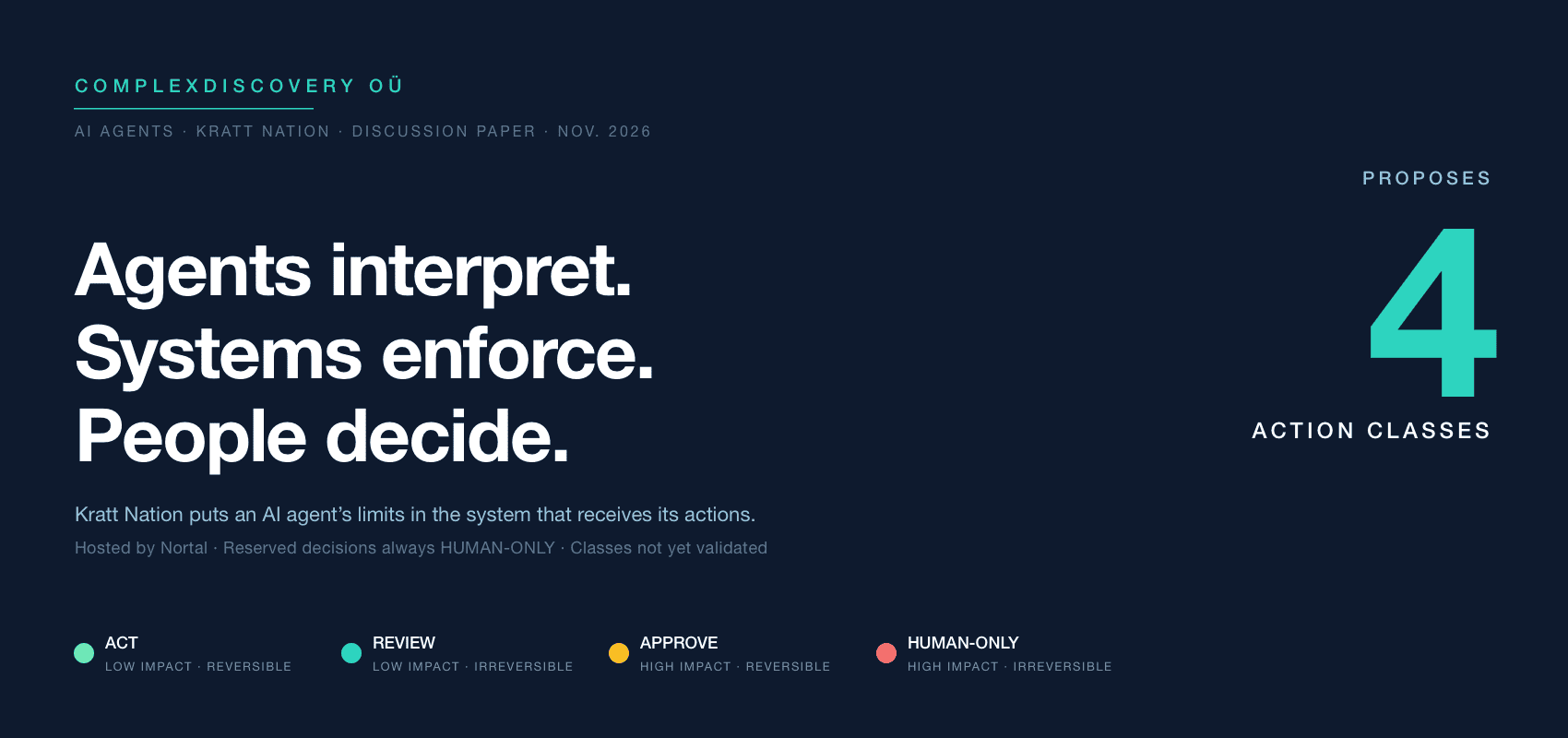
With limits outside the model, the paper turns to how much an agent may do inside them. It proposes four action classes keyed to a step’s consequences and whether it can realistically be reversed. ACT covers low-impact, reversible steps, where the agent acts and a small sample is reviewed; REVIEW covers low-impact steps that cannot be undone and relies on risk-based sampling. APPROVE requires human sign-off before high-impact but reversible steps, and HUMAN-ONLY leaves to a person both high-impact steps that cannot be undone and any step that law or the organization’s policy reserves for people. The organization’s system assigns the class from structured data such as an amount or a recipient, and the paper says an agent’s own description of an action cannot lower it. Legal reservations override the matrix, and existing law can already give people a right to human involvement. The authors point to the EU’s revised Consumer Credit Directive, whose national implementing measures apply from Nov. 20, 2026: where automated processing of personal data is involved in assessing someone’s creditworthiness, those measures include a right to human intervention.
The sampling logic will look familiar to eDiscovery teams that validate technology-assisted review with statistical samples rather than reading every document, though that comparison is this article’s, not the paper’s. Inspecting every REVIEW action would turn review back into routine approval, the authors write, while inspecting none would leave the organization blind to how the agent performs. They call for random samples sized to the stakes and drawn across important case groups, because an average can hide failure in one population. They also weight errors by consequence. “Ten wording errors do not have the same weight as one wrongful rejection,” the paper says.
Before any live autonomy, the authors recommend a shadow trial in which the agent works the same cases as staff without its output reaching customers or changing live cases. An experienced reviewer resolves disagreements “without assuming that the human result is always correct,” they write. The paper also warns that review can decay into a formality. When officials sign off on agent drafts quicker than anyone could read them, two numbers drop: the time spent per review and the portion of drafts that get heavily rewritten. Those same numbers also drop when the agent gets better or the cases get easier, so for a public authority the paper wants its head to weigh them together with sampled reviews, case mix and complaints.
What the record can prove and what it cannot
Evidence is where eDiscovery and information governance readers should slow down. A person’s authenticated confirmation and an agent’s delegated action are different events, the authors write, and should be recorded as such. A qualified electronic signature carries the legal effect of a handwritten one under the EU’s eIDAS Regulation. That legal effect, the paper says, does not mean every authenticated step proves informed intent, since an agent can misread its instructions or be steered by content it encounters.
The log has limits too. It identifies the channel used, the authors write, “although it cannot prove who physically operated the software.” In EU payments, a record of authentication is not by itself necessarily proof that a contested payment was authorized, the paper adds, citing Article 72 of the second Payment Services Directive. Liability, it stresses, turns on the applicable law and the circumstances. Each log should name the agent, the session and the operator and list what was done, under suitable access controls and retention periods. Identifying which agent acted, or listing it on a register, does not establish that it had authority to act.
Liability itself stays unsettled in the paper’s account. Operating a service, answering for its decisions and compensating for harm are separate questions, and depending on the facts and the jurisdiction the bill could land on an agent operator, a producer, a credential issuer or the receiving organization. A user’s authorization does not by itself decide who pays. The authors note that the EU’s revised Product Liability Directive brings software, AI systems included, within its scope. Its new regime, however, applies to products placed on the market or put into service after Dec. 8, 2026, and requires national transposition.
For records managers, the paper’s visibility proposal carries a design constraint. For connected databases, Estonia’s Data Tracker already shows people which organization accessed their data, when and for what purpose, and extending it to agent actions is a proposal the authors call new work. They want those records kept at each organization and retrieved on the person’s request, “avoiding a new central history of the services they use.” For data headed to externally hosted models, the paper adds a reminder: replacing direct identifiers does not on its own anonymize personal data or lift data-protection duties, and free text can hide identifying details that need a second look.
The same questions at the Tallinn Digital Summit
Who authorizes an agent and what record it leaves were also live questions at the Tallinn Digital Summit, which met Nov. 5 and 6 at the National Library of Estonia. The summit material here comes from its published program and ComplexDiscovery’s reports from the hall. Organizers built the invitation-only forum around the question of how to thrive in the agentic era, noting that Estonia chairs both the Nordic-Baltic Eight and Digital Nations in 2026. One of its main-program stages was named the Kratt Stage. Readers should weigh one overlap: the summit lists Nortal among its strategic partners and the Ministry of Justice and Digital Affairs among its organizers.
Prime Minister Kristen Michal said Estonia is drafting rules for AI agents, ComplexDiscovery reported from the opening session. When an agent prepares a tax return or pays bills, he said, people need to know what it may do, what it has already done and who answers for it. That afternoon Freddy Dezeure, Microsoft’s deputy chief information security officer for Europe, told a panel to treat agents as employees, giving each a job description and caps on financial transactions, ComplexDiscovery reported. He also urged organizations to keep a copy of how their systems stood before an agent acts, so the agent’s work can be rolled back.
Two of the paper’s authors were on the program. Raieste joined Skype founding engineer Jaan Tallinn for the closing fireside chat, where, ComplexDiscovery reported, he argued against making AI agents legal entities, reasoning that rules exist to serve humans. The paper draws a similar line, defining an agent’s authorization as a technical permission bound to an accountable person or organization, “not a new legal personality.” The summit lists Grünberg as chief executive of Levira and describes his ministry role, which it calls undersecretary, as a former post. Its agenda scheduled him for a Kratt Stage session on national cyber resilience that asked which state functions “must never be allowed to fail, each with a rehearsed fallback.”
When the agents are switched off
The paper asks for the same kind of rehearsed fallback when an AI model disappears. At the summit, Justice and Digital Affairs Minister Liisa-Ly Pakosta framed the dependence problem by asking where a state’s sovereignty would stand if the price of its AI jumped a hundredfold overnight, ComplexDiscovery reported. The paper’s hardest test is a fictional scenario in which export restrictions force several major model providers to suspend service in Europe, and it anchors that scenario in a narrower real event. Citing the company’s statements, the paper says Anthropic suspended its Fable 5 and Mythos 5 models for all users June 12, 2026, following a U.S. export-control directive. It adds that a July 1 update reported access restored, without detailing the scope of that restoration, and that the company’s other models remained available.
Its answer is operational. No outage or price rise at a model provider should be able to halt an essential service, so staff should routinely work some cases with no agent-prepared drafts. Every procurement involving a model provider should also build in a way to swap it out, with the time and cost of switching known and tested in practice. EU financial institutions already face technology continuity and exit duties under the Digital Operational Resilience Act, the authors note, while other organizations need requirements suited to their own legal setting.
Demand is the other pressure. A 2026 preprint the paper cites identified 84 potential cases, spread over 11 jurisdictions, where officials or other sources attributed a rise in demand on public bodies to AI use. The authors stress that its method shows neither how widespread the effect is nor whether AI caused it, and they urge organizations to track their own caseloads before blaming any single cause.
The paper ends on the same folk image the summit opened with. “Putting a kratt to work means knowing how to handle it,” the authors write, and essential services “must continue to be provided the day the agents are switched off.” The narrator in Tallinn told the audience to keep one end of the rope in hand. Read against the paper, that end is a limit enforced in the receiving system and a record kept outside the agent. If an AI agent acted inside your organization tomorrow, could your systems, rather than the agent’s own account, show who held that end?
News Sources
- Raieste, A., Solvak, M., Siivelt, K., Vaks, T., Tapupere, M., Liivak, P., & Grünberg, T. (2026). Kratt Nation: Dividing work between people, AI agents and rules.
- Kratt Nation (Nortal, University of Tartu and Estonian Centre of Excellence in AI; PDF)
- Kratt Nation | Nortal (Nortal)
- Insights | Nortal (Nortal)
- about | Discover Digital Leadership Opportunities: Tallinn Digital Summit 2026 (Tallinn Digital Summit)
- about | Discover Digital Leadership Opportunities: Tallinn Digital Summit 2026 (Tallinn Digital Summit)
- agenda | Discover the Event Schedule: Tallinn Digital Summit 2026 (Tallinn Digital Summit)
- speakers | Explore Speakers Now: Tallinn Digital Summit 2026 (Tallinn Digital Summit)
- Partners: Tallinn Digital Summit 2026 (Tallinn Digital Summit)
- Tallinn Digital Summit opens on who holds the rope in the agentic era (ComplexDiscovery)
- Tallinn Digital Summit’s first afternoon finds Europe slow where AI agents are fast (ComplexDiscovery)
- Tallinn Digital Summit’s second morning asks who controls the AI Europe runs on (ComplexDiscovery)
- Tallinn Digital Summit closes on whether humans can still check what AI does (ComplexDiscovery)




Assisted by GAI and LLM Technologies
Additional reading
- Nine months across Europe’s tech-sovereignty arc, from Tallinn to London
- The flame and the frontier: how Estonia carries a 1919 victory into a tense 2026
- Estonia aims to be first to give AI agents official digital IDs
Source: ComplexDiscovery OÜ

ComplexDiscovery’s mission is to enable clarity for complex decisions by providing independent, data‑driven reporting, research, and commentary that make digital risk, legal technology, and regulatory change more legible for practitioners, policymakers, and business leaders.