Editor’s Note: Estonia’s Internal Security Service, known as KAPO, says Russia’s military intelligence agency, the GRU, coordinated an attempted arson attack on drone maker Threod Systems in Viimsi, near Tallinn, early Nov. 14, 2026. Threod’s security team and a joint operation by KAPO and Latvia’s State Security Service, which had passed on warnings beforehand, stopped it. Eight people were detained; prosecutors sought custody for five, and Estonia’s prosecutor general said a court has ordered two of them held.
On Nov. 15, Estonia’s Foreign Ministry said the government plans to close the country’s road crossings with Russia from Dec. 1, saying the move would curb Russia’s ability to act against Estonia and reduce the risk of sanctions evasion. Russia’s Foreign Ministry spokeswoman said the plan, if real, would be a new outburst of Russophobia.
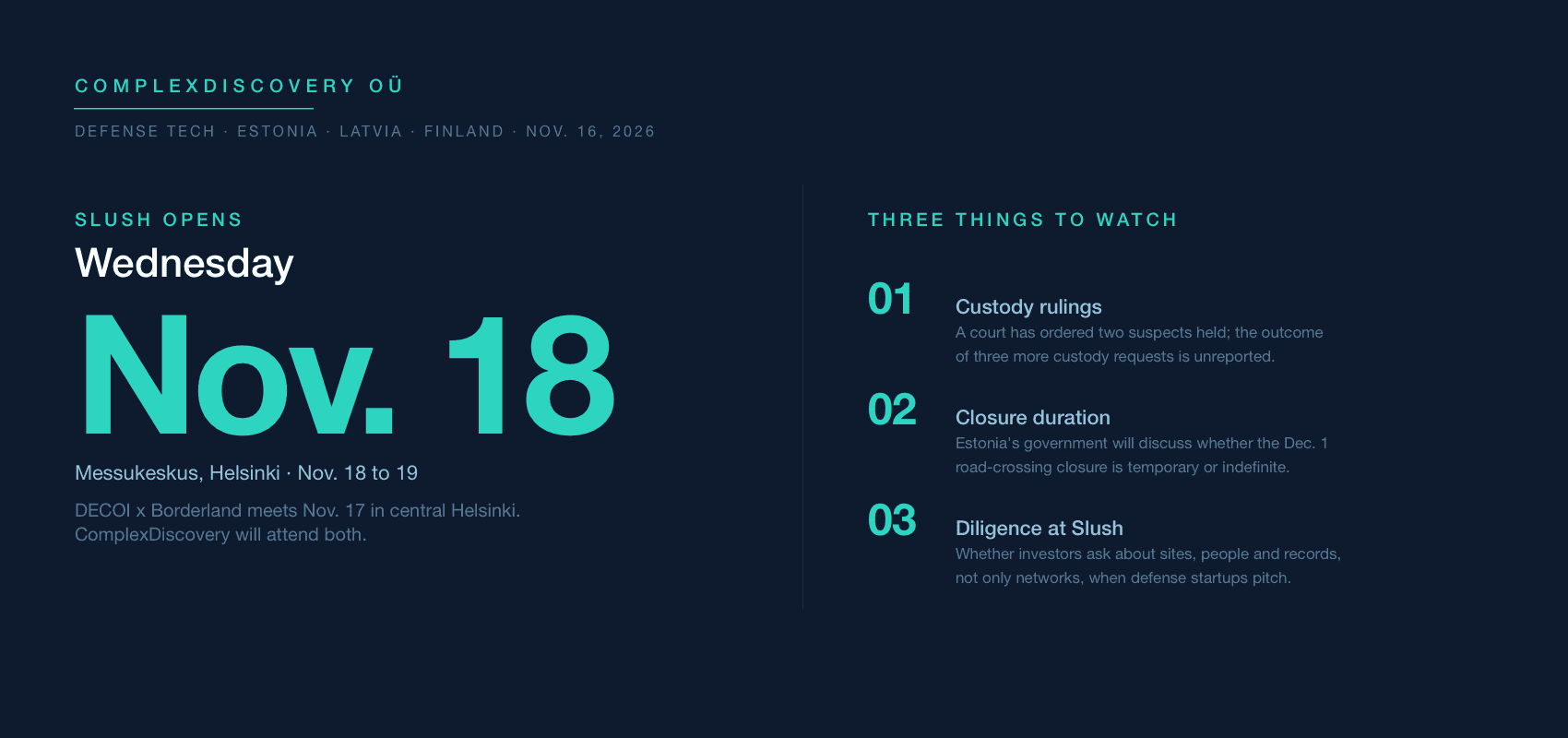
For cybersecurity, information governance and eDiscovery professionals, the case moves physical security, public registry exposure and the preservation of camera footage and access logs into defense-tech diligence. Watch whether Estonia makes the closure temporary or indefinite, how the court rules on the remaining custody requests, and whether defense sessions around Slush in Helsinki, Nov. 17 to 19, take up the attack.
Content Assessment: Days before Slush, an attack on Estonian drone maker Threod raises the stakes for defense tech
Information - 94%
Insight - 93%
Relevance - 92%
Objectivity - 92%
Authority - 92%
93%
Excellent
A short percentage-based assessment of the qualitative benefit expressed as a percentage of positive reception of the recent article from ComplexDiscovery OÜ titled, "Days before Slush, an attack on Estonian drone maker Threod raises the stakes for defense tech."
News Analysis – Geopolitics Beat
Days before Slush, an attack on Estonian drone maker Threod raises the stakes for defense tech
ComplexDiscovery Staff
Threod Systems’ security team and a joint Estonian-Latvian security-service operation stopped an attempted arson attack on the drone maker’s Viimsi premises Nov. 14, an attack Estonia’s Internal Security Service says Russian military intelligence coordinated.
By Sunday, Estonia’s government had announced plans to close its road crossings with Russia. For founders and investors gathering at Slush in Helsinki this week, the episode raises the stakes for defense tech, putting a company’s sites, people and records alongside its networks in the security conversation.
What investigators say happened in Viimsi
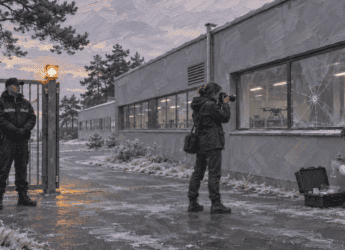
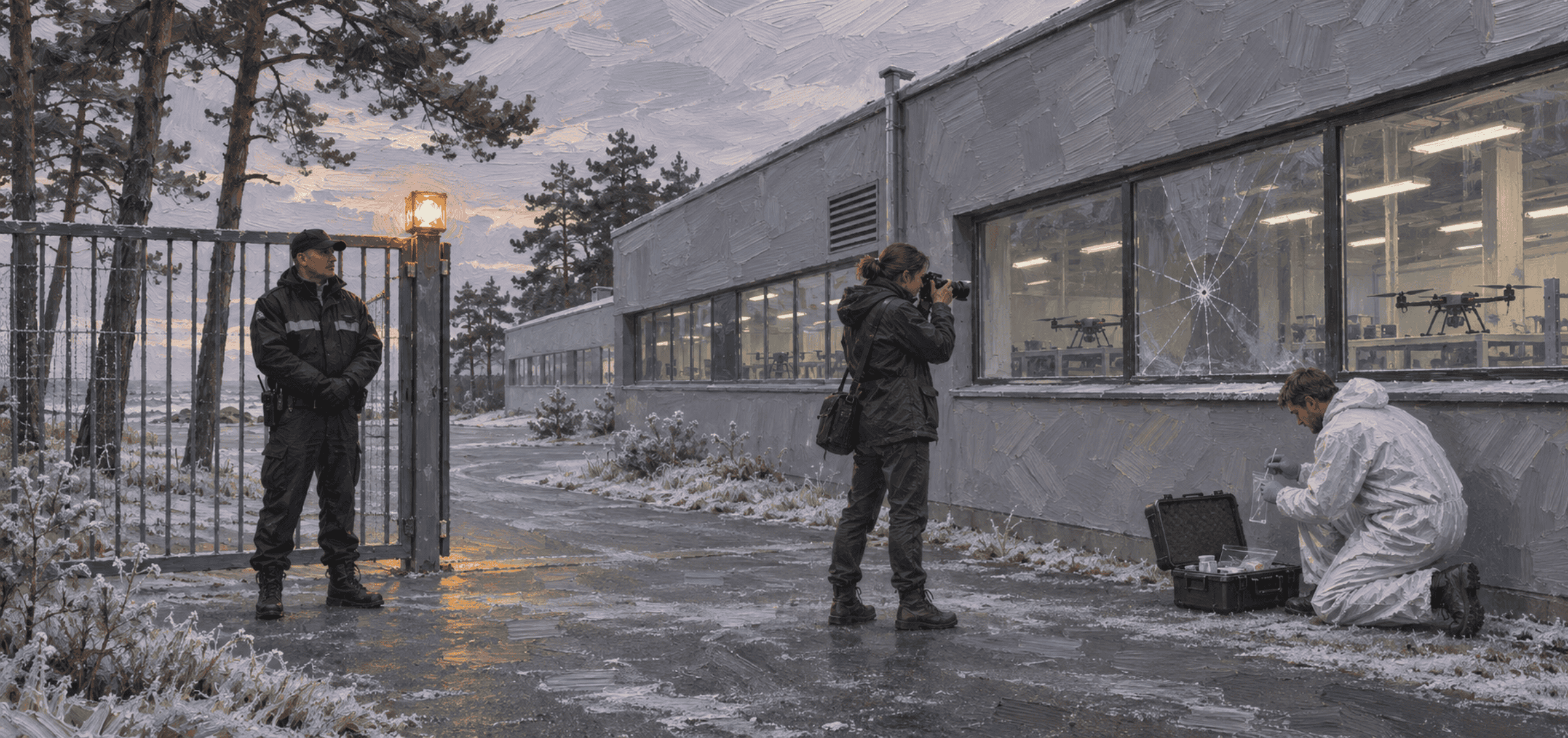
Prosecutor General Astrid Asi said the break-in attempt came at about 3:06 a.m. Saturday and that Threod’s own security team thwarted it, according to ERR News, the English service of Estonia’s public broadcaster. Margo Palloson, director general of the Internal Security Service, known by its Estonian acronym KAPO, said counterintelligence had established that Russia was behind the operation, a finding that has not yet been tested in court. He said the GRU, Russia’s military intelligence agency, coordinated it, and that the plan was to smash windows and pour flammable liquid inside to start a fire and an explosion. Nobody was hurt, and Palloson said the company’s production and delivery capabilities were unaffected, LSM, Latvia’s public broadcaster, reported.
Threod, founded in 2012 and based in Viimsi Parish near Tallinn, develops unmanned aircraft and surveillance systems, according to Euronews, and ERR described it as a maker of long-range reconnaissance and attack drones. A Reuters report carried by ERR’s Estonian-language service called it a drone company that supplies Ukraine. Estonian World, an English-language publication covering Estonia, reported that the company’s technology supports British military drone programs.
Investigators were already moving before the attempt came. Latvia’s State Security Service, known as VDD, said that on Nov. 13 and 14 it passed KAPO risk information about possible sabotage plans in Estonia. The two services then launched jointly coordinated activities, and eight people were detained on Estonian territory overnight Nov. 14, according to VDD. VDD described all eight as Latvian nationals; Estonian World reported that Latvian authorities identified four as citizens and four as holders of Latvia’s non-citizen status, a separate legal category for some long-term residents who do not hold citizenship. Prosecutors asked a court to hold five of the suspects in custody. At an afternoon press conference Nov. 15, Asi said a court had ordered custody for two Latvian residents, LSM reported; the outcome of the other three requests has not been reported. Asi said investigators will look at who organized the attack, what part each suspect played and whether anyone else was involved.
Palloson described a recruitment pattern that matters to anyone screening the people who come onto a defense site. The GRU recruits European Union residents who can move freely within the Schengen Area, he said, often drawing on criminal circles or on people under financial strain, according to ERR News. VDD said separately that Russia’s intelligence agencies are turning more often to recruits who hold other countries’ citizenship for sabotage in Europe, a tactic it says is meant to hide the trail back to Moscow.
Nor is Threod the first target this year. It is the second known Estonian defense company hit by attempted arson in 2026, after a mid-August fire at a Tallinn building used by Milrem Robotics. Milrem has supplied THeMIS unmanned ground vehicles to Ukraine. On Sept. 29, the Internal Security Service said it had concluded that the attack “was a deliberate and pre-planned act commissioned by Russian security services,” the Associated Press reported. Three suspects were detained in Latvia and handed over to Estonia. Kremlin spokesman Dmitry Peskov called such statements unfounded, according to the AP.
Border plan arrives the next day
Estonia’s political answer to the Threod attempt came the following day. Prime Minister Kristen Michal said Sunday that he had discussed closing the border with Interior Minister Igor Taro. He asked Taro and the Government Office to prepare the necessary steps, and Taro said his proposal to the government would shut every road crossing with Russia to both pedestrians and vehicles as December begins. A Foreign Ministry release dated Nov. 15 said the government plans to close the Estonia-Russia road crossings from Dec. 1, in response to what it called a GRU-ordered sabotage attempt against Threod.
Foreign Minister Margus Tsahkna said in that release that the closure would reduce Russia’s ability to act against Estonia and help mitigate risks tied to sanctions evasion. He also said he had contacted his counterparts in Finland, Latvia and Lithuania. Tsahkna’s own social media post spoke of closing all border crossing points, while the ministry release refers only to road crossings. Rail is being handled separately. Taro said Monday that the Narva railway crossing will initially stay open on the Estonian side so imports of strategically important raw materials can continue while companies find alternatives, ERR News reported. The statements reviewed for this article do not address the Koidula rail crossing.
Several details remain open. A longer-term closure requires a government decision, and Taro said the government would discuss at the end of the week whether the closure would be temporary or indefinite. Estonian residents and truck drivers now in Russia would get two weeks to come back.
The Russian response reported so far addressed the border plan. Russian Foreign Ministry spokeswoman Maria Zakharova told the state news agency TASS that, if the plans were real, they would be a new outburst of Russophobia, ERR reported, citing Reuters. The reporting reviewed for this article contains no Russian response to KAPO’s attribution of the Threod attack itself.
Slush’s host country closed its own crossings long ago, for a different stated reason. Finland’s land crossings with Russia have been shut since Dec. 15, 2023, a measure its government ties to the threat of instrumentalized migration, meaning the use of migrants to pressure a neighbor. On June 4, 2026, the Finnish government decided to keep the crossings closed until further notice, according to Finland’s Ministry of the Interior.
Why physical security now belongs in diligence
A border closure guards the state’s perimeter, but for defense companies the perimeter that matters most is their own, and Estonian officials had warned that companies like Threod were in the line of fire. In a Sept. 29 interview on ERR’s Aktuaalne kaamera news program, Palloson said Russia’s emphasis had moved from symbolic sites to defense-industry companies, with the goal of stopping military aid from reaching Ukraine. He urged those firms to strengthen their cyber defenses.
The industry’s own association had already acted after the earlier fire. Kalev Koidumäe, chief executive of the Estonian Defence and Aerospace Industry Association, told ERR the same day that the association had worked with state security agencies following the Milrem attack to give member companies guidance on preparing risk mitigation plans.
Koidumäe also pointed to an exposure that sits in public view. Where several defense companies sit is freely available online, he said, and their ownership is visible in Estonia’s Business Register; the association has asked that public access to some of that information be limited in light of the security situation. He added that startups tend to concentrate on product development, so the association briefs them on risk, beginning with cybersecurity and extending to physical security, and that developers themselves may be at risk as well as buildings.
Threod’s defenses held, and Michal pointed to preparation. In a social media post Sunday reported by Euronews, the prime minister credited stepped-up security and a swift law enforcement response with preventing extensive damage from the attempted attack. Estonian World reported that he also said Threod had followed the security recommendations issued to defense companies.
For investors, that record argues for treating physical security as a diligence line item beside cyber posture and export compliance. Investors and counsel can ask whether a company has a written risk mitigation plan that covers sites and people as well as networks. They can ask how it vets contractors, couriers and night-shift staff, and what its registry filings and press photos reveal about facility locations and owners’ addresses. Whether insurers or investors will reprice that risk for Baltic defense startups is an open question, and none of the officials quoted in the reporting reviewed addressed it.
Evidence that crosses borders before the case does
The Threod case also shows how quickly a security incident becomes a cross-border evidence matter, because the suspects live in Latvia, the target sits in Estonia and the investigation runs through both countries. When VDD searched nine places in Latvia tied to the suspects Nov. 14, the agency said, officers seized explosives, pyrotechnics and ammunition, plus a large haul of phones and other storage media.
For the victim company, its own records can become evidence the moment the alarm sounds. Camera footage, access-control logs, guard reports, visitor registers and badge data may all be sought by investigators, and their value depends on whether they were preserved intact with a documented chain of custody. Information governance teams at defense startups should set retention periods for security footage and access logs before an incident and decide who is authorized to export them. They should also rehearse a legal hold that suspends deletion for the specific cameras, logs and accounts involved, so that the first night does not depend on improvisation. Legal teams should plan for requests from investigators in two countries and for how internal messages about the incident will be handled.
Questions to carry into Slush week
Helsinki offers a week of chances to put those diligence and evidence questions to the companies themselves. Slush’s main event runs Nov. 18 to 19 at Messukeskus, Helsinki’s expo and convention center, with Investor Day at Finlandia Hall and founders’ programs at Tanssin Talo on Nov. 17, according to the organizer. Defense has its own stage that week. The Finnish Business Angels Network says DECOI, an investor-driven defense innovation platform it founded in 2023, joins with the Borderland network of Eastern Finland for the first time Nov. 17 in central Helsinki. The network describes a one-day summit of keynotes, panels and pitches for 500 curated participants, with 14 defense and dual-use startups and scaleups selected to pitch.
Whether any of those sessions take up the Threod attack is not yet known. The questions are straightforward enough to ask in a hallway: how a founder vets the people who touch the site, what the company could hand investigators by dawn, and whether its public footprint shows an attacker where to go. ComplexDiscovery will attend DECOI on Nov. 17 and Slush on Nov. 18 to 19 and will put those questions to defense founders and investors there.
At Threod, the attack was stopped by two layers working together: warnings passed between Latvian and Estonian services beforehand, and a company security team on site when the attempt came. For defense startups pitching in Helsinki this week, which part of the diligence file covers the people on site and the partners who warn them?
News sources
- Välisminister Tsahkna: sulgeme Eesti-Venemaa maanteepiiripunktid (Estonian Ministry of Foreign Affairs)
- VDD provides support to KAPO in preventing a sabotage act in Estonia (Latvian State Security Service)
- Finland’s eastern border to remain closed until further notice (Finnish Ministry of the Interior)
- Slush 2026 is a Bet on Europe (Slush)
- Event Info (Slush)
- DECOI x Borderland 2026 (Finnish Business Angels Network)
- 8 detained after GRU-linked arson at Estonian drone company Threod Systems (ERR News)
- Estonia to close border crossings with Russia after GRU-linked sabotage attacks (ERR News)
- Minister: Closing the border with Russia directly affects few people (ERR News)
- Eight Latvian nationals arrested over suspected Estonia drone arson plot (LSM)
- Igaunijā aizturēti astoņi cilvēki no Latvijas par mēģinājumu uzbrukt aizsardzības nozares uzņēmumam (LSM)
- Estonia’s proposed eastern border closures are ‘Russophobia,’ Russian MFA says (ERR News)
- Venemaa näeb Eesti otsuses piir sulgeda russofoobiat (ERR, citing Reuters)
- Katri Raik: piiri sulgemine on Narvale valus (ERR)
- GRU püüdis Eestis toime panna järjekordset rünnakut (Koiduaeg)
- Palloson: kapo on hoidnud ära märkimisväärse hulga Venemaa rünnakuid (ERR)
- Kaitsetööstuse liidu juht: Eesti militaarettevõtted on Venemaa huviorbiidis (ERR)
- Estonia plans to close its road crossings with Russia after an attack on drone maker Threod (Estonian World)
- Estonian drone maker targeted in ‘GRU-ordered’ sabotage attempt, PM says (Euronews)
- Estonia Foils GRU-Ordered Sabotage Attack on Drone Maker Threod Systems (Kyiv Post)
- Estonia blames Russia for arson attack on defense company (Associated Press)
- Estonia blames Russia in arson attack on military robotics firm Milrem (Defense News)
- Slush 2026 brings a smaller, sharper bet on European startups to Helsinki (ComplexDiscovery)
- How Finland Is Reshaping Defense: BORDERLAND at Slush 2025 (ComplexDiscovery)

Assisted by GAI and LLM Technologies
Additional reading
- Before the Abu Dhabi talks, a claimed Rosstat leak and hacked alert apps test what can be confirmed
- Spoofed nuclear alert caps four days of Ukraine war assessments that separate claims from evidence
- Kyiv says Starshield speeds are back, but who capped them is still disputed
- Diesel license, Starshield cap and intelligence warnings strain US support for Ukraine
- Drones hit two Yandex data centers, and a Kremlin decree sets terms for state management
- A cell tower near Lyman and Russia’s fight over its own war record
- How a general’s walk across a bridge tested Putin’s claim to Svyatohirsk
- Germany names Russia for the Leipzig drone, and keeps most of its evidence out of view
- Estonia scrambled jets over a drone no official has identified
- Russia leans on drones and dissent-proofing as fuel crisis bites
- Senate passes Graham sanctions act, shifting Russia pressure from policy to statute
Source: ComplexDiscovery OÜ

ComplexDiscovery’s mission is to enable clarity for complex decisions by providing independent, data‑driven reporting, research, and commentary that make digital risk, legal technology, and regulatory change more legible for practitioners, policymakers, and business leaders.