

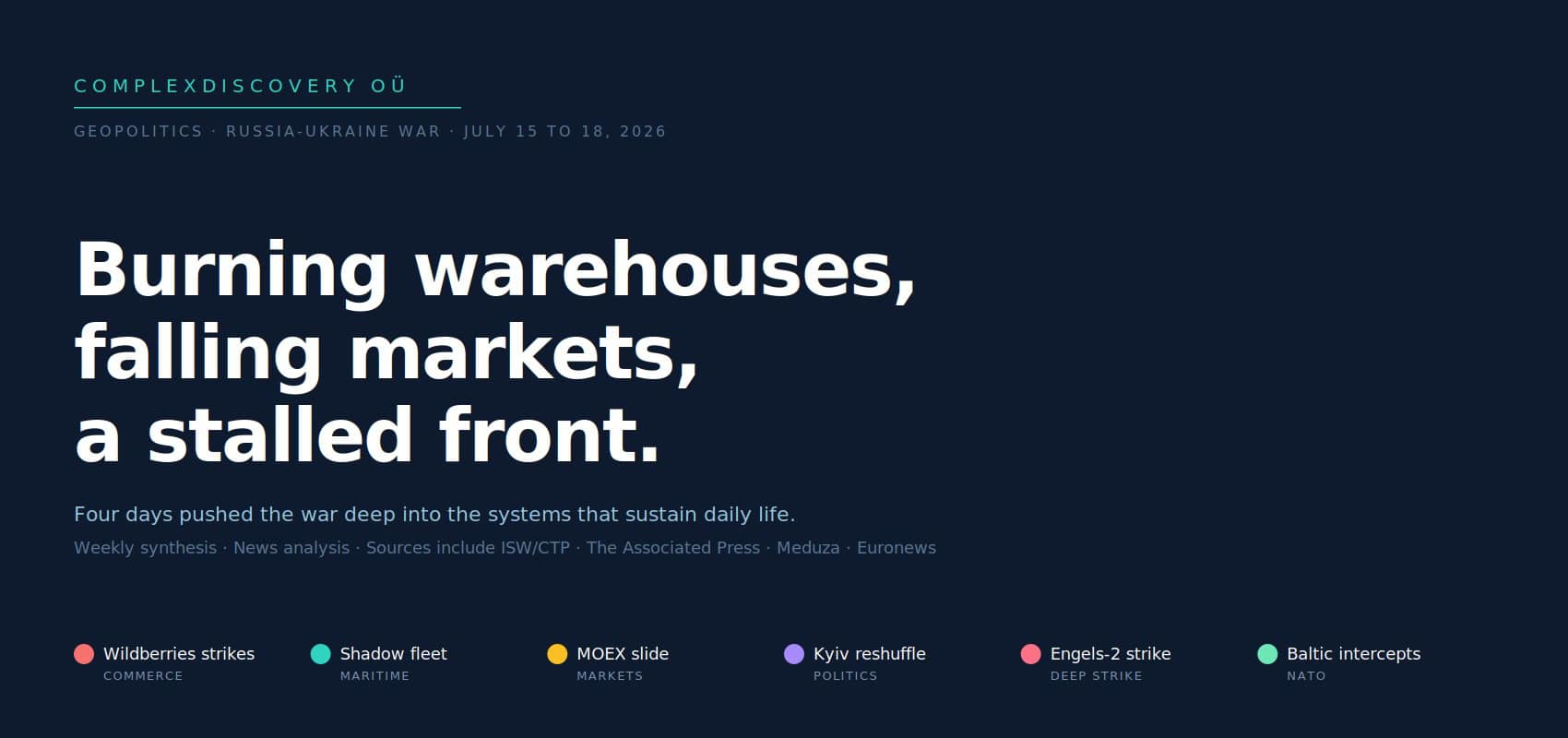
Editor’s Note: Warehouses that fill Russia’s online shopping orders burned this week, and those fires say as much about the direction of the war as any map of the front. Between July 15 and July 18, Ukrainian strikes reached e-commerce logistics hubs, shadow fleet tankers, refineries and, by Kyiv’s account, a strategic bomber, while Moscow’s stock exchange posted its steepest one-day drop since 2022 and President Vladimir Putin’s approval slid by 5 points in a week.
For cybersecurity, data privacy, regulatory compliance and eDiscovery professionals, the week reads as a working brief. Sanctioned components allegedly moving through consumer logistics networks, Indian gasoline reaching Russia through a ship-to-ship transfer, and satellite data independently testing official statements all touch the disciplines of trade screening, supply chain diligence and evidence verification.
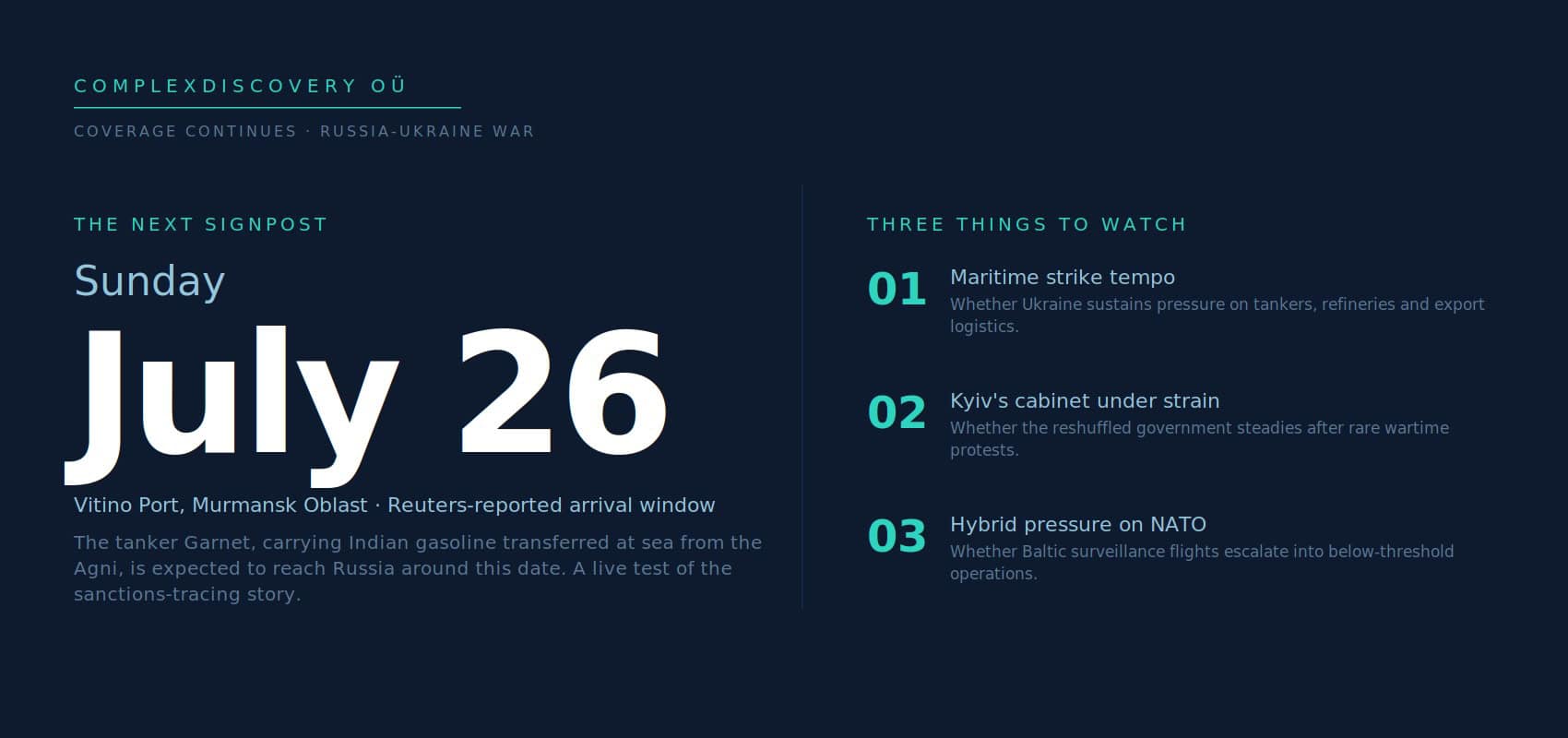
Watch three threads from here: whether Ukraine sustains its maritime and refinery campaign, whether Kyiv’s reshuffled cabinet steadies after rare wartime protests, and whether hybrid pressure on NATO’s eastern flank escalates beyond surveillance flights.
Content Assessment: The week the war reached Russia’s e-commerce supply chain
Information - 93%
Insight - 92%
Relevance - 90%
Objectivity - 90%
Authority - 93%
92%
Excellent
A short percentage-based assessment of the qualitative benefit expressed as a percentage of positive reception of the recent article from ComplexDiscovery OÜ titled, "The week the war reached Russia’s e-commerce supply chain."
Industry News – Geopolitics Beat
The week the war reached Russia’s e-commerce supply chain
ComplexDiscovery Staff
The fires that lit the sky over Elektrostal, east of Moscow, and Kotovsk, in Russia’s Tambov region, overnight from July 17 into July 18 did not start at military bases. They started in fulfillment centers serving Russian shoppers.
By morning, Russian officials counted nine dead and over 80 wounded across the overnight attack series, according to The Associated Press, with most of the casualties at facilities of Wildberries, the country’s largest online retailer.
The strikes on two Wildberries logistics hubs closed a four-day stretch, July 15 through July 18, in which the war between Russia and Ukraine looked less like a contest of trenches and increasingly like a contest of systems: logistics networks, refining capacity, shipping lanes, equity markets, and the information channels through which both governments claim success. For professionals who track sanctions exposure, supply chain risk, and information integrity, the week offered a compressed case study in how a modern war is now fought and measured.
Commerce becomes a target set
Ukrainian drones struck the two Wildberries warehouses in waves through the night. Seven warehouse workers died in Kotovsk and 25 were wounded there, according to Russian regional officials cited by CBS News. Moscow Region Governor Andrei Vorobyov said 37 people were wounded in his region, one of whom later died in a hospital. CNN described the attacks as among the deadliest Ukrainian strikes inside Russia in two years.
Ukrainian President Volodymyr Zelenskyy characterized the facilities as part of a sanctioned-component supply chain. “These facilities were used by the aggressor to supply sanctioned components for the production of drones and navigation equipment,” he said in remarks reported by CBS News.
The claim, which has not been independently verified, reframes an e-commerce fulfillment network as a sanctions-evasion artery. Meduza reported that Wildberries may have lost the use of 10 to 15 percent of its warehouse space, citing The Bell; the company has published no damage assessment of its own. Wildberries founder Tatyana Kim called it “a terrible night, terrible events for our company and for our country” and pledged support for victims’ families, Novaya Gazeta Europe reported. Two points deserve separation here. Trade compliance teams should take the practical one: screening obligations do not stop at the freight forwarder, and dual-use components can travel through consumer logistics channels that rarely appear on traditional risk maps. The legal one is narrower: even if sanctioned components moved through a fulfillment center, that alone would not settle whether the facility was a lawful military objective, a question the law of armed conflict answers through a separate test of effective contribution to military action and definite military advantage, and one no public evidence yet permits outsiders to assess. Russia’s defense ministry, for its part, said its air defenses intercepted 379 Ukrainian drones across 19 regions and occupied Crimea overnight, a figure that could not be independently confirmed.
Tankers, refineries and a bomber Russia no longer builds
The warehouse strikes extended a campaign that spent the week working through Russia’s energy and maritime logistics. Unmanned Systems Forces Commander Robert “Madyar” Brovdi said on July 18 that Ukrainian drones struck 172 Russian vessels in the Black Sea and Sea of Azov between July 6 and July 18, a tally that includes tankers linked to Russia’s sanctions-evading shadow fleet and that has not been independently verified. Analysts at the Institute for the Study of War (ISW) assessed that the maritime campaign is pulling elite Russian drone units away from the front line and squeezing energy and agricultural logistics at the same time.
Refineries burned too. Ukrainian strikes hit the Slavneft-YANOS refinery complex in Yaroslavl during the week, and the cumulative damage to Russian refining capacity has begun producing a result few would have predicted three years ago: Russia is importing gasoline from India. Reuters reported that the tanker Agni departed India’s Vadinar Port with 42,000 metric tons of gasoline in mid-June, transferred the cargo at sea to a second tanker, the Garnet, near Egypt in early July, and that the Garnet is expected at Vitino Port in Murmansk around July 26. Sanctions investigators scrutinize such ship-to-ship transfers because they can complicate cargo tracing.
The most symbolically loaded strike of the week came at Engels-2 air base in Saratov Oblast, roughly 800 kilometers from the Ukrainian border. Ukraine’s Security Service said it critically damaged a Tu-95MS strategic bomber there, releasing footage it said showed the aircraft’s tail section severed. The claimed loss had not been independently confirmed, and Russian authorities did not acknowledge it. The Tu-95 is an airframe the Soviet Union stopped producing decades ago and Russia no longer builds. “We are increasing the price Russia pays for its aggression against our country and our people,” Zelenskyy said in remarks reported by the Kyiv Independent.
The systems war ran in both directions. Russian missile and drone strikes during the window kept working through Ukrainian energy facilities and Black Sea port infrastructure, part of a campaign that, Reuters reported, citing industry sources and a Ukrainian Agri Council report, had eliminated about one-third of Ukraine’s Black Sea grain-export capacity. The July 15 assessment recorded Russia resuming strikes against Ukrainian port infrastructure with the assessed aim of degrading the economy and export capacity, and overnight packages through the week ran to 146 drones and multiple ballistic and cruise missiles in a single night. Ukraine’s warehouses, substations and ports have absorbed this pressure for years; what changed this week is how much of it Russia absorbed in return.
Moscow’s markets and pollsters flash warnings
Numbers inside Russia told their own story. The Moscow Exchange composite index fell 4.24 percent on July 16, its steepest single-day drop since September 2022. Gazprom shares touched 83.98 rubles the same day, an all-time low that undercut a record standing since October 2008, after The Wall Street Journal reported that talks with China over the Power of Siberia 2 pipeline had stalled on price. VTB Bank shares also hit a record low.
Polling released that week pointed to a separate source of domestic strain. Russia’s state-affiliated Public Opinion Foundation recorded a 5 percentage point drop in President Vladimir Putin’s approval rating in its July 10 to 12 survey, to about 66 percent, which Meduza characterized as the steepest weekly decline since the full-scale invasion began. The state-run pollster VTsIOM measured approval at 65.1 percent. Fuel shortages, internet restrictions and a blocked Telegram figured among the causes cited. Bloomberg reported that wealthy Russians, including associates of Putin, have been shifting assets toward cryptocurrency, gold and foreign property amid concerns about Kremlin nationalization.
None of this means the Russian state is buckling. It does mean the financial data trail, from tanker transponders to exchange indices to satellite imagery, now offers outside analysts a near-real-time read on strain that the Kremlin cannot fully script.
Kyiv reshuffles its government under fire
Ukraine spent the same week absorbing a political storm of its own. Defense Minister Mykhailo Fedorov, a popular figure credited with building Ukraine’s drone and technology programs, lost his post in a government reshuffle initiated by President Zelenskyy, triggering protests in Kyiv and cities across the country, a rare wartime display of public dissent. Parliament confirmed Serhii Koretskyi, who had led the state energy company Naftogaz since 2025, as prime minister on July 16 with 289 votes, replacing Yulia Svyrydenko.
David Arakhamia, who heads Zelenskyy’s parliamentary faction, said Koretskyi’s energy experience “will be invaluable, especially now as Ukraine prepares for what could be the most difficult winter in its history,” according to Euronews.
The fallout and the reshuffle moved on separate tracks. Serhiy Beskrestnov, a prominent drone and electronic warfare adviser, announced after Fedorov’s dismissal that he would no longer assist the defense ministry. Vitalii Kim, by contrast, left the Mykolaiv governorship because parliament appointed him veterans affairs minister in the new cabinet. Wartime governance, the week demonstrated, is itself contested terrain, and personnel files can move markets and morale as surely as artillery.
A front line measured in motorcycles
The ground war, by contrast, barely moved. ISW recorded no confirmed advances by either side on July 17 or July 18 across the major axes in Donetsk, Kharkiv and Zaporizhia oblasts, a finding about available evidence rather than proof that no movement occurred. Russia’s defense ministry is prioritizing motorcycles, buggies and all-terrain vehicles over armored mechanized systems, a procurement pattern ISW read as a commitment to slow, grinding positional warfare. A Ukrainian officer in the Slovyansk direction said Russian assaults have climbed from five to seven per day in the spring to as many as 26 daily, with Russian forces relying on small infiltration groups rather than mechanized columns.
Claims outran evidence on both sides of the information front. Russian Chief of the General Staff Valery Gerasimov announced advances in Donetsk Oblast that ISW found uncorroborated by available visual evidence. The discipline that catches such gaps, matching official statements against geolocated footage and satellite data, is the same discipline eDiscovery and investigations professionals apply to any contested record. Meduza, citing NASA VIIRS Black Marble satellite data, reported that nighttime illumination across occupied Crimea had fallen to roughly one-fifth of normal levels at the end of June and had not recovered, a data-driven check on official reassurances about conditions on the peninsula.
Beyond Ukraine, Polish and Swedish fighters intercepted two Russian Su-30SM2 jets over the Baltic Sea during NATO air defense exercises, a day after allied jets intercepted a Russian Il-20 reconnaissance plane; neither incident was reported as an airspace violation. “Russia is testing the alliance’s readiness in this way,” Polish Deputy Prime Minister Wladyslaw Kosiniak-Kamysz said. Warsaw and Baltic governments have said Russia may stage a false flag operation against NATO territory, and Ukrainska Pravda reported earlier this month that Washington warned Poland that Moscow may test the alliance with a hybrid attack, an operation that could involve cyber, sabotage or information activity before, or instead of, any conventional attack. The week’s daily assessments recorded no negotiation developments.
What the week’s ledger says
Add the four days up and the pattern is hard to miss. The war’s center of gravity kept shifting away from the trench line and toward the systems that sustain it: warehouses, tankers, refineries, stock exchanges, polling desks and cabinet rooms. Professionals responsible for sanctions compliance should track the India-to-Russia fuel route and the components moving through consumer logistics networks. Those responsible for information integrity should note how satellite data and geolocated footage repeatedly tested official claims from both capitals, and how often the officials came up short.
The fires will be extinguished, and Wildberries can reroute orders through other facilities while it rebuilds. The harder question lingers past the smoke: when a war is waged against the systems that deliver daily life, from gasoline to groceries to next-day packages, how should the professionals who safeguard those systems, in any country, decide what counts as critical infrastructure worth protecting first?
News sources
- Russian Offensive Campaign Assessment, July 18, 2026 (Institute for the Study of War)
- Russian Offensive Campaign Assessment, July 17, 2026 (Institute for the Study of War)
- Russian Offensive Campaign Assessment, July 16, 2026 (Institute for the Study of War)
- Russian Offensive Campaign Assessment, July 15, 2026 (Institute for the Study of War)
- Ukrainian drone attacks on Russian warehouses and oil depot kill at least 9, injure over 60 (CBS News)
- Warehouse workers among 8 dead in deadliest Ukrainian attacks inside Russia for two years (CNN)
- Wildberries may have lost the use of 10 to 15 percent of its warehouse space, source tells The Bell (Meduza)
- Russia’s state gas giant Gazprom drops to an all-time low on the Moscow Exchange (Meduza)
- Putin’s approval rating just posted its steepest drop since Russia invaded Ukraine (Meduza)
- Ukrainian parliament backs new wartime cabinet amid scandal over defense minister dismissal (Euronews)
- Russian Tu-95 bomber suffered critical damage in strike on Engels air base, Zelensky says (Kyiv Independent)
- Russia turns to Indian gasoline imports as fuel shortages deepen after refinery attacks (bne IntelliNews)
- Russian surveillance flights trigger NATO intercepts over Baltic Sea (Stars and Stripes)
- Ukrainian drones hit warehouses and other sites across Russia, killing 9 and wounding over 80 (The Associated Press)
- Ukraine says 172 Russian shadow fleet vessels struck in Operation MoLoCHKa (Interfax-Ukraine)
- Rada appoints Kim as minister for veterans affairs (Interfax-Ukraine)
- Ukrainian parliament appoints Koretskyi as prime minister (Kyiv Independent)
- Protocol Additional to the Geneva Conventions (Protocol I), Article 52: general protection of civilian objects (ICRC IHL Databases)
- MOEX Russia Index (IMOEX) historical values (Moscow Exchange)
- At least eight people killed in Ukrainian strikes on online retailer warehouses across Russia (Novaya Gazeta Europe)
- Inside Ukraine’s strike on Russia’s online retail giant Wildberries (Meduza)

Assisted by GAI and LLM Technologies
Additional reading
- The three silent hours: How Russia’s cyber war targets Ukraine’s newsrooms
- Confirmed versus claimed: reading the gap in Russia’s June offensive
- When the flag may be fake: Ukraine’s June war and the new burden of proof
- When the drone war reaches the reactor fence: Ukraine and the cyber-physical front
- When the refineries burn: Ukraine’s strikes turn Russia’s energy backbone into a cautionary tale
- The night Ukrainian drones exposed gaps in Moscow’s defenses and state TV gave it 60 seconds
- From warning to funding: Russia’s expanding media machine and the risk signals ahead
- Invisible by design: NATO’s 2026 cognitive warfare paper and the crisis of discovery
- When Your Legal Tech Vendor Gets Breached: DocketWise Incident Exposes 116,666 Immigration Records and a Profession’s Blind Spot
- The DOJ’s Cyber FCA Playbook Is Working as Enforcement Triples and Shows No Signs of Slowing
- FTC’s OkCupid Action Reframes AI Training Data as a Consumer Protection Issue
- White House AI Framework Signals New Compliance Stakes for Legal, Cybersecurity, and eDiscovery
- The Gatekeeper’s Key: How the Conformity Assessment Unlocks the EU AI Market
Source: ComplexDiscovery OÜ

ComplexDiscovery’s mission is to enable clarity for complex decisions by providing independent, data‑driven reporting, research, and commentary that make digital risk, legal technology, and regulatory change more legible for practitioners, policymakers, and business leaders.