Editor’s Note: Enforcement architecture built in Washington has become a planning input for boardrooms in Warsaw, Prague, and Bucharest. On July 14, the U.S. Justice and Homeland Security departments published a joint trade fraud enforcement guide as their task force claimed a tally exceeding $1 billion in recoveries, penalties, forfeitures, and charged losses.
For cybersecurity, data privacy, regulatory compliance, and eDiscovery professionals across Europe, the development matters because customs cases are document cases: entry records, broker emails, and origin certificates may become evidence sought during an investigation or subsequent litigation, and GDPR can complicate cross-border productions containing personal data. The region’s nearshoring growth, its overlap with the 12 forced labor priority sectors, and the June suspension of de minimis treatment place its exporters squarely within the new enforcement perimeter.
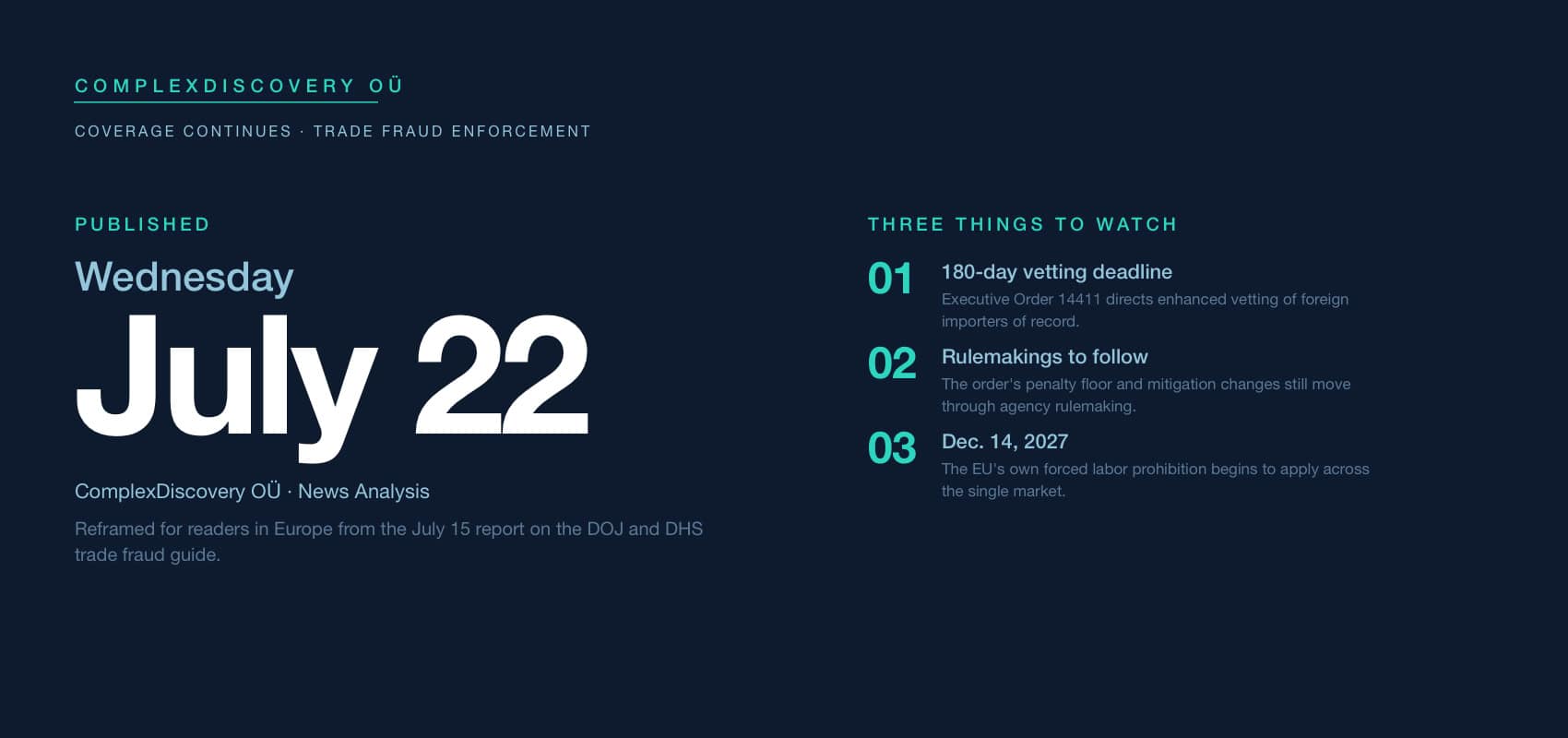
Watch three developments: the 180-day vetting deadline under Executive Order 14411, the rulemakings the order set in motion, and Dec. 14, 2027, when the EU’s own forced labor prohibition begins to apply. Preparation windows close faster than order books grow.
Content Assessment: US trade fraud enforcement reaches into Europe's supply chains
Information - 93%
Insight - 92%
Relevance - 92%
Objectivity - 93%
Authority - 92%
92%
Excellent
A short percentage-based assessment of the qualitative benefit expressed as a percentage of positive reception of the recent article from ComplexDiscovery OÜ titled, "US trade fraud enforcement reaches into Europe's supply chains."
Industry News – Data Privacy and Protection Beat
US trade fraud enforcement reaches into Europe’s supply chains
ComplexDiscovery Staff
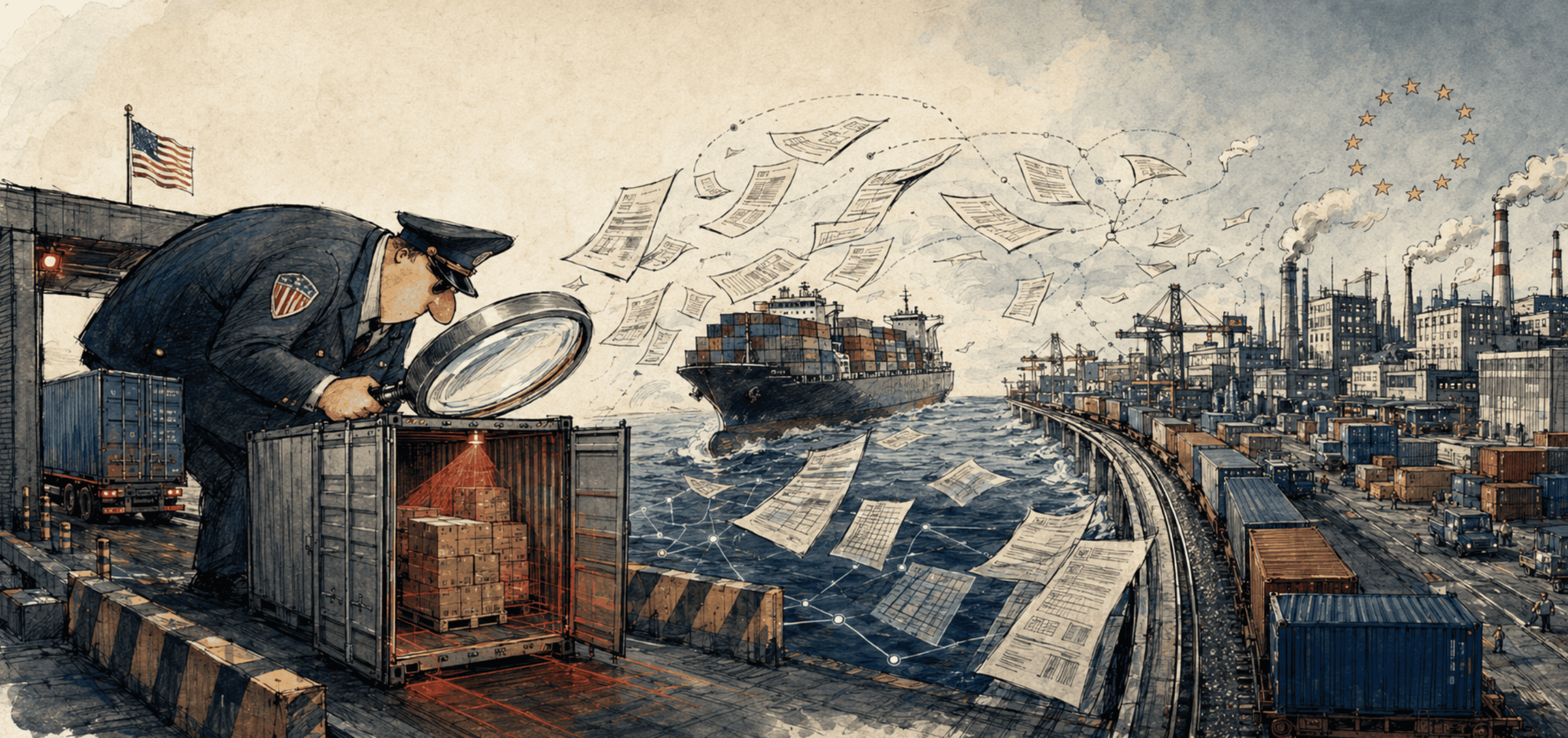
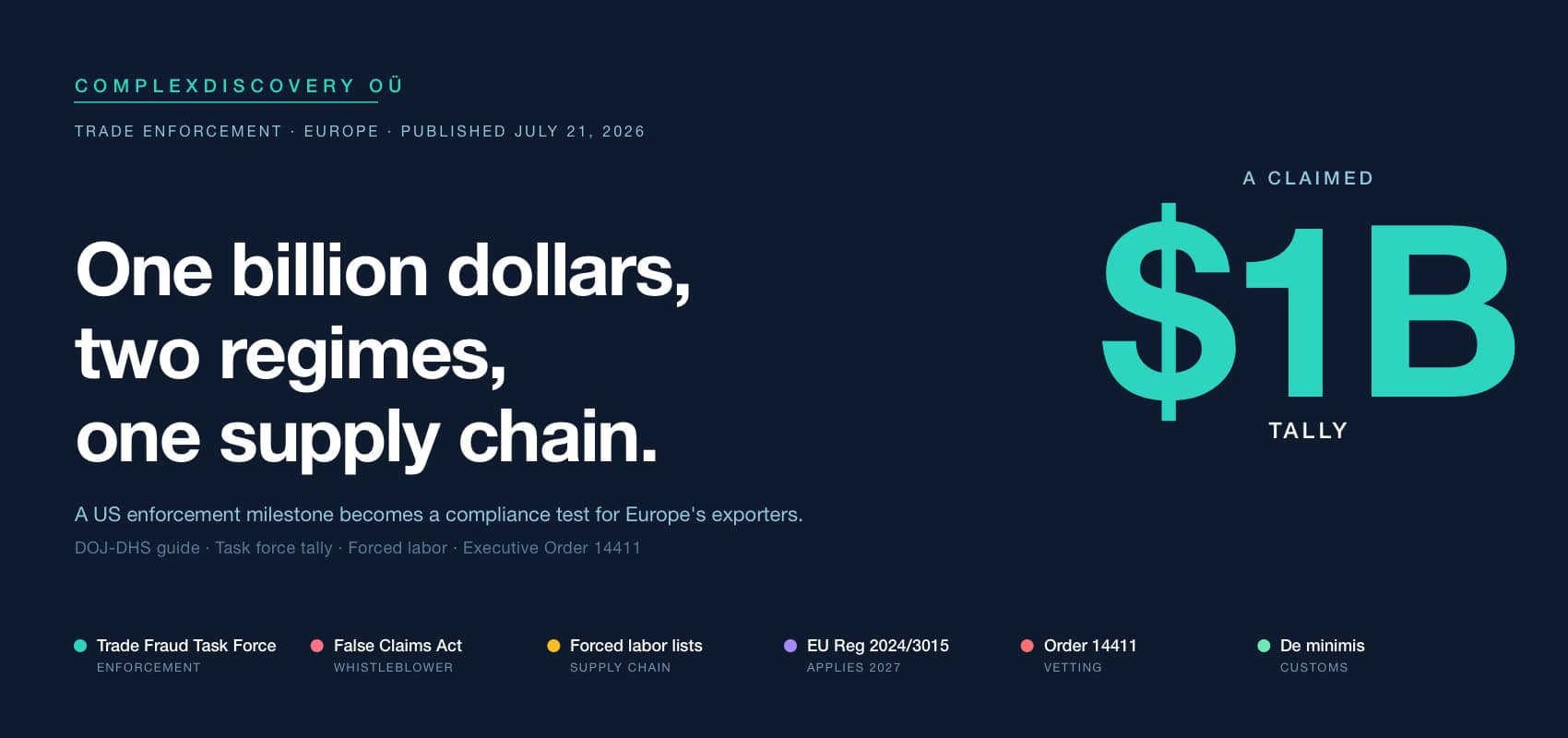
The U.S. Justice and Homeland Security departments published a joint trade fraud enforcement guide July 14 as their task force claimed over $1 billion in recoveries, penalties, forfeitures, and publicly charged losses. The guide centers on the U.S. import system. The exposure it describes runs straight through Europe.
From the Baltics to the Balkans, the region has spent five years building itself into Europe’s nearshoring hub, pulling manufacturing closer to Western European customers. Most of that output stays inside the EU, which takes about three-quarters of Poland’s exports, but the share that travels on to the United States, $14.48 billion from Poland alone in 2025, is what the new American enforcement architecture is built to interrogate.
A scorecard, not a cash total
Start with the number, because the number needs unpacking. The Justice Department describes the $1 billion figure as “civil and criminal recoveries, penalties, forfeitures, and publicly charged losses” accumulated since the Trade Fraud Task Force launched in August 2025. Charged losses are allegations, not outcomes. The largest single component of the tally is a $549.5 million settlement with Perfectus Aluminum announced May 12, 2026, resolving conduct that produced criminal convictions before the task force existed.
The remainder includes a settlement of roughly $54 million with cutting-tool maker Ceratizit USA in December 2025 and pending criminal charges against individuals in California and Illinois accused of disguising Indian and Emirati jewelry as Singaporean or Omani to avoid about $51.6 million in combined duties. Those defendants are presumed innocent, and the charged amounts may never be recovered. Read as a government scorecard rather than a cash total, the figure still tells European exporters something real: the law firm Akin attributes roughly $640 million of it to False Claims Act matters, and the department has now made the effort permanent by creating a Global Trade and Commerce Enforcement Section, according to client analyses from Akin and ArentFox Schiff.
The guide itself is informational, not law. By its own terms, it creates no enforceable rights or defenses and is not legal advice. What it offers is a public reference to how American prosecutors see customs fraud: sixteen recurring patterns, from false country-of-origin declarations and undervaluation to shell company schemes and port shopping, mapped against the statutes used to charge them.
Where the region enters the picture
European companies already appear in the government’s case studies. The guide cites a $22 million False Claims Act settlement with a German multinational over false free trade agreement claims and a $1.9 million drawback fraud resolution with a German toolmaker. “Any imported good that presents a risk to our revenue, our safety, or our values usually begins with a lie,” the guide states. Assistant Attorney General Colin McDonald said in the July 14 announcement that trade fraud is a serious economic crime.
For European businesses, three statutory features matter most. First, liability under the smuggling statute reaches down the chain to anyone who fraudulently or knowingly receives, conceals, buys, or sells illegally imported goods, which can pull distributors and U.S. subsidiaries of regional manufacturers into scope, depending on the facts and each party’s knowledge. Second, the False Claims Act can impose treble damages where a person knowingly avoids or decreases an obligation to pay customs duties, including through false import declarations, with knowing defined to include deliberate ignorance and reckless disregard, and it pays whistleblowers a share of recoveries. An employee in a Bratislava logistics office or a Bucharest finance team could file a qui tam action in U.S. federal court if the statutory and jurisdictional requirements are met. Third, conspiracy and aiding-and-abetting theories can reach foreign participants who knowingly assist a scheme directed at U.S. imports, subject to applicable jurisdictional and territorial limits, and the guide describes double-invoicing schemes as conspiracies between foreign manufacturers and importers.
None of this converts published priorities into automatic liability. Fair-notice, due-process, and statutory-interpretation defenses remain fact-specific and available, and a guide that creates no rights also creates no presumptions against a defendant. What changes is the probability of scrutiny, not the elements the government must prove.
Transshipment pressure is already visible in the region
The kinds of document fraud and cross-border customs evasion cataloged in the guide are not hypothetical in Central and Eastern Europe. In April 2026, the European Anti-Fraud Office reported uncovering an alleged scheme that moved Chinese textiles, footwear, and electric bicycles through Poland’s border with Belarus using falsified transit documents and shell companies, evading about 118 million euros in customs duties and 79 million euros in VAT, in a case involving coordinated controls in Belgium, Slovenia, Germany, Hungary, and Poland. Nine suspects were detained and are presumed innocent unless convicted; the European Public Prosecutor’s Office opened a criminal investigation in Poland.
The case concerned EU customs and VAT evasion rather than a U.S. country-of-origin charge. Its alleged use of falsified documents, shell companies, and cross-border routing nevertheless resembles several typologies in the U.S. guide, and the incentive is growing on both sides of the Atlantic. Washington’s tariff structure now runs from a 15 percent all-inclusive ceiling on most EU goods under the August 2025 joint statement to rates of up to 50 percent on many steel and aluminum products under Section 232, a differential that rewards misclassification and origin-washing. The EU adopted its implementing regulations on June 25, 2026, yet friction persists: in May, EU Trade Commissioner Maros Sefcovic pressed Washington through a Commission spokesperson for a swift return to the agreed 15 percent terms after some EU exports faced stacked duties near 30 percent.
The region’s e-commerce sellers face a quieter version of the same squeeze. U.S. Customs and Border Protection (CBP) made the suspension of the $800 de minimis exemption indefinite in rules published June 24. Nonpostal low-value shipments a seller in Vilnius or Sofia sends to an American customer generally require formal or informal entry; for international mail, CBP’s new postal informal-entry process takes effect July 24. Covered shipments are subject to any applicable duties, and undervaluing them is one of the fraud patterns the new guide names.
Regional manufacturers assembling Chinese components for U.S.-bound goods should treat substantial transformation as a legal test, not a marketing claim. If the work done in Debrecen or Craiova does not genuinely change the article’s name, character, or use, declaring EU origin on a U.S. entry may be a false declaration, with the applicable origin rule and product-specific facts controlling the analysis.
Forced labor rules now run on two tracks
The guide devotes sustained attention to forced labor enforcement, and here the compliance calendar doubles. On the American side, the interagency Forced Labor Enforcement Task Force has expanded its high-priority sectors from four to 12, adding aluminum, steel, copper, lithium, PVC, seafood, caustic soda, and jujubes (red dates) to the original apparel, cotton, silica-based products including polysilicon, and tomatoes. Several of those additions sit at the center of the region’s industrial base, from Polish copper and steel to the Hungarian and Serbian battery corridor built substantially on Chinese investment. Under the Uyghur Forced Labor Prevention Act, goods with inputs from China’s Xinjiang region are presumed barred from U.S. entry unless the importer rebuts the presumption with clear and convincing evidence.
On the European side, Regulation 2024/3015 will prohibit placing products made with forced labor on the EU market, or exporting them from it, beginning Dec. 14, 2027. The European Commission will lead investigations involving conduct outside the EU. An integrated supply chain map can support compliance with both regimes, although their legal standards and procedures differ; a manufacturer that builds none will answer to each separately.
Documents decide these cases
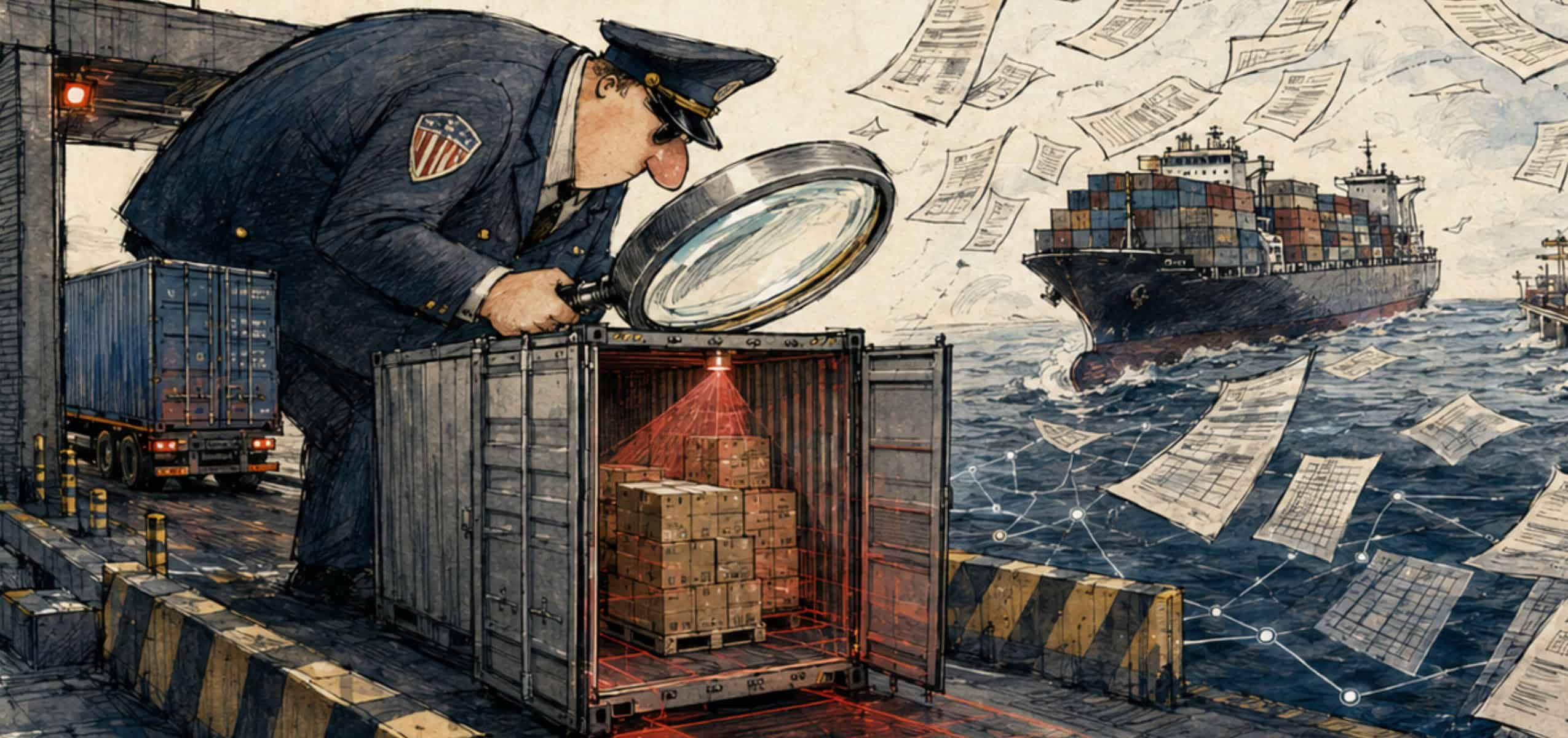
For information governance and eDiscovery professionals, the practical lesson of the guide is that customs cases are document cases. Entry records, commercial invoices, broker emails, origin certificates, and payment trails may become evidence sought in discovery or by subpoena once a False Claims Act complaint is unsealed or a grand jury acts. U.S. record-keeping rules require importers to retain entry records for five years, and Executive Order 14411, signed June 3, directs the Department of Homeland Security to build enhanced vetting for foreign importers of record, customs brokers, and freight forwarders within 180 days. The order also directs a minimum penalty floor of 50 percent of the assessed penalty, absent exceptional circumstances that materially impact national security, and the elimination of mitigation for repeat offenders. Those are instructions to agencies, with rulemaking to follow, not final rules today.
European counsel should also plan now for the collision between American discovery demands and the EU’s data protection regime. Producing personnel emails and supplier records to the Justice Department can implicate GDPR transfer rules when the records contain personal data, and companies that wait for a subpoena to think through lawful transfer mechanisms lose weeks they will not get back. A documented data map, a litigation hold procedure that works across EU entities, and counsel briefed on both regimes are the difference between a manageable inquiry and an unforced error.
What regional exporters should do before the rules harden
The immediate work is unglamorous. Map every product flow that touches the United States, including sales through German or Dutch intermediaries, because potential exposure can extend beyond the first invoice when downstream participants possess the required knowledge. Test origin claims against the substantial transformation standard with documentation that would survive a skeptical auditor. Obtain supplier attestations, and where possible input-level traceability, for any of the 12 priority sectors. Review who acts as importer of record into the U.S. and whether that entity could pass the vetting regime the executive order contemplates. And treat internal complaints about customs practices as early warnings: with Akin attributing roughly $640 million of the tally to False Claims Act matters, the employee who raises a concern internally today could become a relator tomorrow.
Europe built its export growth on being the trustworthy alternative in a suspicious world. The question the next 18 months will answer is whether the region’s compliance infrastructure can grow as fast as its order books: when U.S. and EU enforcers both come asking where a product was really made, how many of the region’s exporters can prove the answer?
Disclaimer: This article provides general news and analysis and does not constitute legal advice. Customs, trade, forced labor, and data protection obligations depend on the facts and applicable jurisdiction; consult qualified counsel regarding a specific matter.
News sources
- A Resource Guide to Trade Fraud Enforcement (U.S. Department of Justice and U.S. Department of Homeland Security)
- Trade Fraud Task Force Surpasses $1 Billion in Recoveries and Charged Losses in Less Than One Year (U.S. Department of Justice)
- Strengthening Customs Enforcement, Executive Order 14411 (Federal Register)
- Indefinite Suspension of the De Minimis Exemption (Federal Register)
- Indefinite Suspension of the De Minimis Exemption for Mail Shipments and New Postal Informal Entry (Federal Register)
- DOJ Trade Fraud Task Force Surpasses $1 Billion in Recoveries; Announces Permanent Enforcement Section (ArentFox Schiff)
- OLAF plays a central role in uncovering a major VAT and customs fraud involving imports of undeclared goods (European Anti-Fraud Office)
- EU-US trade: Council and Parliament strike a deal to implement the tariff elements of the Joint Statement (Council of the European Union)
- EU Implements Tariff Commitments Under the EU-U.S. Trade Deal (Sullivan & Cromwell)
- A Billion-Dollar Milestone: The Trade Fraud Task Force Signals a New Era of Criminal and Civil Trade Enforcement (Akin)
- EU Forced Labour Regulation published in the Official Journal (Linklaters)
- EU trade chief urges US to ‘swiftly’ restore 15% tariff arrangement (Euronews)
- United States Imports from Poland (Trading Economics, UN Comtrade)
- DOJ and DHS issue trade fraud guide as task force tally exceeds $1 billion (ComplexDiscovery)

Assisted by GAI and LLM technologies
Additional reading
- UK and EU impose first simultaneous cyber sanctions as Poland attack is attributed to the FSB
- The negotiator was the leak: insider who betrayed ransomware victims gets 70 months
- Why a single Signal recovery key is a preservation problem
- Europe’s critical sectors are maturing, but seven still sit in ENISA’s risk zone
- When the worm targets the assistant: Miasma turns AI coding agents into the trigger
- Glasswing widens: Anthropic puts Mythos inside power, water and hospital operators across more than 15 countries
- Canvas breach moves from disclosure to demand as ShinyHunters sets May 12 deadline
- CISA’s CI Fortify rewrites the disconnection playbook for critical infrastructure
- A 48-month federal benchmark resets the incident-response insider question
- Data collection in occupied territory: A closer read of Cyber Law Toolkit scenario 35
- Cyber Law Toolkit tests surveillance and data collection under occupation
Source: ComplexDiscovery OÜ
ComplexDiscovery’s mission is to enable clarity for complex decisions by providing independent, data‑driven reporting, research, and commentary that make digital risk, legal technology, and regulatory change more legible for practitioners, policymakers, and business leaders.