
Editor’s Note: A ruler whose banned stockpiles were gone spent more than a decade persuading the world they might remain. The U.S. Army’s own history of the war that followed concluded that its lone clear winner appeared to be Iran—the rival the ambiguity was meant to deter. This analysis follows that strategy from the FBI’s 2004 interviews with Saddam Hussein into the boardroom, where a recognizable version of the mechanism runs every quarter: offerings announced ahead of capability, earnings sustained by starving investment, and revenue booked ahead of the economics. Enron anchors the corporate case, the research record quantifies the quieter legal habit, and the analysis is explicit about what the analogy can and cannot carry.
The professional stakes are immediate. Securities and consumer-protection regulators moved against unsupported AI capability claims in 2024 and 2025, from the SEC’s early AI-washing settlements through the Presto Automation action and the FTC’s finalized DoNotPay order. Sales decks and security questionnaires may become discoverable when relevant to a claim or defense, placing greater diligence responsibilities on technology buyers. Cybersecurity, data privacy, regulatory compliance, information governance, and eDiscovery professionals increasingly serve as the inspectors responsible for testing whether asserted capabilities withstand verification.
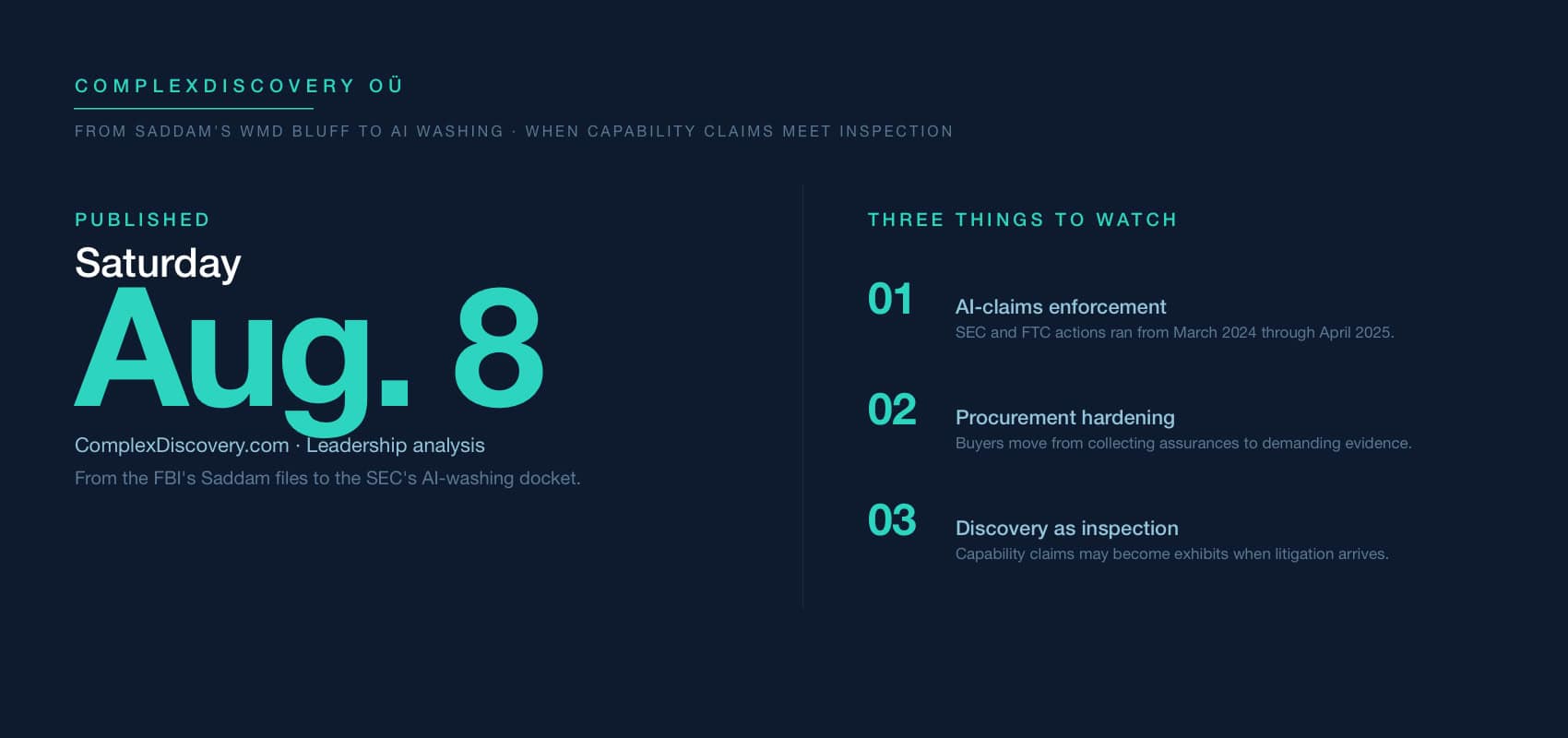
Watch next: whether AI-claims enforcement expands and whether procurement shifts from collecting assurances to demanding evidence.
Content Assessment: From Saddam's WMD bluff to AI washing: when capability claims meet inspection
Information - 94%
Insight - 95%
Relevance - 91%
Objectivity - 91%
Authority - 92%
93%
Excellent
A short percentage-based assessment of the qualitative benefit expressed as a percentage of positive reception of the recent article from ComplexDiscovery OÜ titled, "From Saddam's WMD bluff to AI washing: when capability claims meet inspection."
News Analysis – Leadership Beat
From Saddam’s WMD bluff to AI washing: when capability claims meet inspection
ComplexDiscovery Staff
For five months in 2004, FBI agent George Piro sat with Saddam Hussein in a room near the Baghdad airport, circling the question at the center of the stated case for war: why let the world believe in an arsenal that was gone?
The answer belongs in every boardroom where a product is announced before it works and a quarter is engineered before it is earned.
In today’s enforcement docket, one version of that gap between claimed and demonstrated capability has a name: AI washing.
Saddam’s explanation came out slowly. The FBI logged 20 formal interviews and at least five casual conversations, and it was in one of the casual ones, on June 11, 2004, that he explained himself. In the summaries declassified and released by the National Security Archive in 2009, he is recorded saying he worried less about American consequences for refusing United Nations inspections than about Iran discovering how weak Iraq had become, because inspectors moving freely would show Tehran where Iraq could be hurt. The fuller interpretation, that Saddam was deliberately preserving the perception of an arsenal, came from Piro, who told CBS News in 2008 that Saddam believed the perception was what had kept Iran from attacking again.
It was a self-serving account from a man tending his legend. But separate postwar investigations, drawing on captured records and interviews with detained officials, broadly supported the explanation.
A bluff aimed east
Iraq’s unconventional arsenal had been real once. Saddam’s forces used chemical weapons against Iran in the 1980s and against Iraqi Kurds at Halabja in 1988. After the 1991 Persian Gulf War, U.N. Security Council Resolution 687 ordered that arsenal dismantled and the dismantling verified. The CIA-led Iraq Survey Group later concluded the stockpiles were in fact destroyed in 1991 and 1992 and never rebuilt. The destruction was carried out in secret, though, without the disclosure and verification the resolution demanded, so Iraq remained in breach of its inspection obligations even as the weapons themselves disappeared.
What survived was the appearance. Through the 1990s, Iraq repeatedly obstructed the U.N. Special Commission’s inspectors, declaring presidential sites off limits and confiscating documents. Baghdad ended cooperation outright in October 1998; inspectors withdrew that December, ahead of American and British airstrikes, and did not return for four years. Each episode of defiance fed a global inference that Iraq was hiding an arsenal.
That inference was the product. The Iraq Survey Group’s final report, published Sept. 30, 2004, and known as the Duelfer Report, concluded that Saddam’s paramount goal was escaping sanctions while keeping the scientists and know-how to rebuild weapons programs later, and that fear of Iran, above every other consideration, drove the ambiguity. The report described a state whose strategic direction was set by one man and no one else. A separate U.S. Joint Forces Command study, built from captured records and interviews with detained Iraqi leaders, added the interior view: Saddam labored to convince Western governments the weapons were gone while letting Iran, and much of his own command structure, believe they remained.
Even the generals believed it
The study, called the Iraqi Perspectives Project, drew on over 100 interviews and half a million captured documents. Senior officials told interviewers they knew of no weapons of mass destruction, yet a large share conceded that such weapons might exist somewhere outside their own compartment. The bluff had worked so well that the people planning Iraq’s defense assumed weapons their own state no longer had.
Reality broke through too late to be believed. Facing an American military buildup, Iraq readmitted inspectors in November 2002 under Security Council Resolution 1441. On Feb. 14, 2003, Hans Blix, the chief U.N. inspector, reported over 400 inspections at over 300 sites and no weapons of mass destruction found, though accounting questions from the 1990s remained open. After a decade of concealment, sudden transparency read as one more trick; the study’s authors wrote in Foreign Affairs that years of deception had made the truth itself unconvincing.
The invasion began March 20, 2003. Baghdad fell in three weeks. Saddam’s sons died in a firefight with American troops that July; he was pulled from a hole near Tikrit in December and executed three years later. The rival the bluff was built to deter collected the winnings: the U.S. Army’s own two-volume history of the war, released in January 2019, concluded that the war’s lone clear winner appeared to be Iran.
Iraqi deception fed the uncertainty; it did not compel the invasion, and the official record is blunt about the other links in the chain. The Senate Intelligence Committee concluded in 2004 that most of the major judgments in the prewar intelligence estimate were overstated or unsupported by the underlying reporting. The presidential commission that followed, in 2005, found the intelligence community wrong in nearly all of its major prewar judgments about Iraq’s weapons. Analysts converted ambiguity into certainty, policymakers converted assessment into war, and those failures had owners of their own; no bluff made the choices for them. What Saddam’s strategy did was set the board: it manufactured belief in weapons stocks that no longer existed, then could not dismantle the belief when survival depended on it.
Enron and the corporate version
The corporate translation is an analogy, and an imperfect one. Executives do not run police states; motive, setting, legal status and consequence all differ, and no market failure ends in occupation. What survives the translation is a mechanism: projecting capability to deter rivals and attract capital through announcements, demonstrations and confident opacity. When the projection runs ahead of the underlying substance, leadership is running a launch-and-hope strategy, shipping the claim, skipping the diligence and hoping nobody conducts an inspection.
Enron ran the corporate version at scale. Fortune named Enron America’s most innovative company six years running. The company ranked seventh on the Fortune 500, and its shares peaked around $90 in August 2000. Starting in 1992, with Securities and Exchange Commission staff permission that covered specified gas-trading transactions, Enron used mark-to-market accounting, booking projected profits from long-term contracts when the deals were signed. The method can be defensible where markets are liquid and models are honest. Enron applied it to decades-long agreements priced against its own assumptions, then reported the assumptions as income.
The broadband chapter turned embellishment into doctrine. In July 2000, Enron announced a 20-year agreement with Blockbuster to pipe movies on demand into American homes. The venture reached roughly a thousand pilot users, produced almost no revenue and dissolved in March 2001. Yet through a structure later described as fraudulent in federal charges, Enron recognized roughly $111 million in revenue from it across two quarters, according to the Justice Department. The offering barely existed. The revenue was booked anyway.
Then an inspector knocked. On an April 17, 2001, earnings call, Richard Grubman, a managing director at the hedge fund Highfields Capital Management, asked why a company trading like a financial institution could not produce a balance sheet alongside its earnings release. Enron Chief Executive Jeffrey Skilling thanked him and attached a profanity. The exchange survives as a symptom: Enron treated requests for verification the way Baghdad treated weapons inspectors, as hostile acts to repel rather than chances to prove strength.
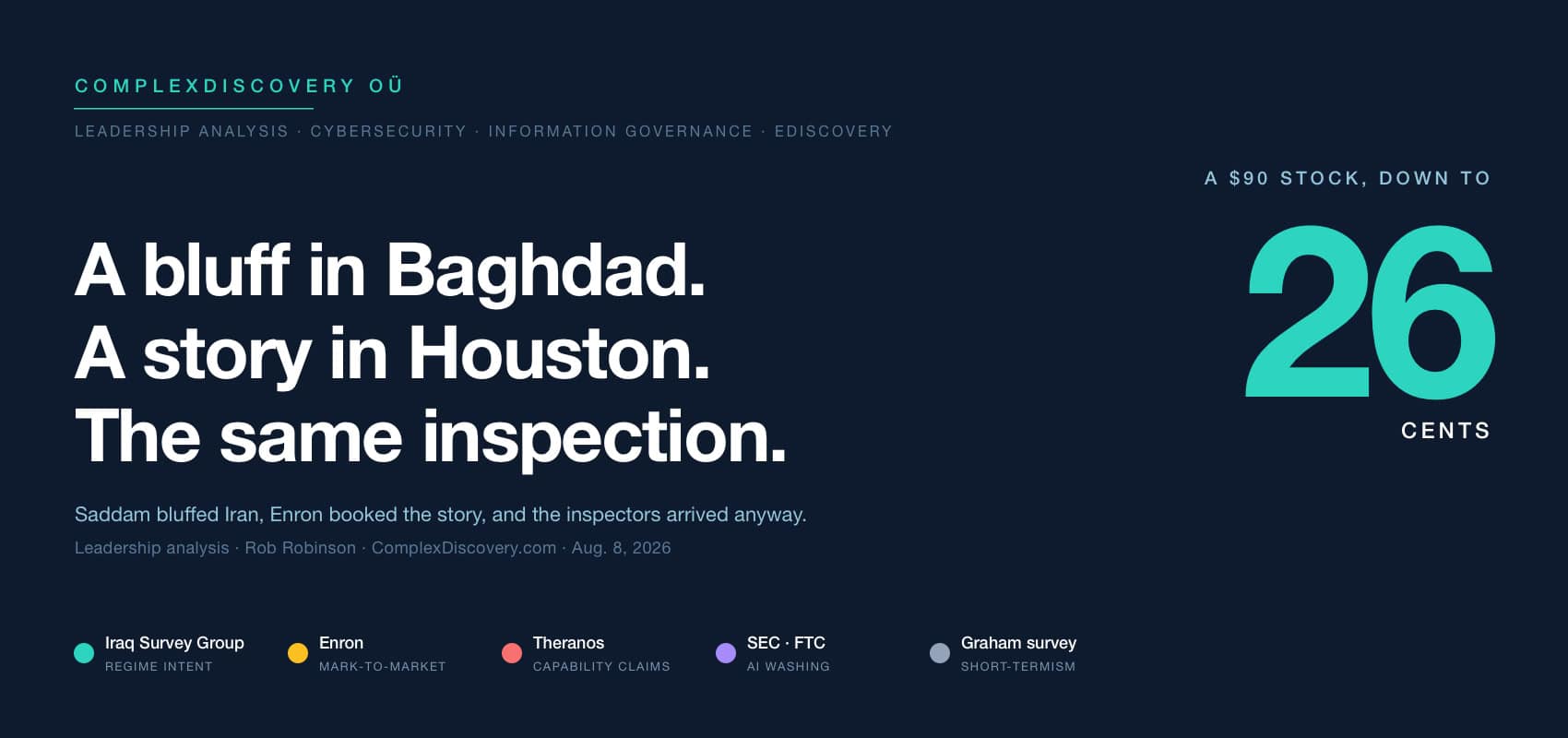
Skilling resigned that August. On Oct. 16, 2001, Enron announced a $1.01 billion after-tax charge against third-quarter earnings and a $1.2 billion reduction in shareholders’ equity. The SEC opened an inquiry within days. On Nov. 8, the company restated years of results, cutting reported profits by $586 million after consolidating the off-books partnerships that had concealed its debt. A rescue merger collapsed, credit agencies cut the company to junk and the stock that had touched $90 closed at 26 cents on Nov. 30. Enron filed for bankruptcy protection on Dec. 2, 2001, with $63.4 billion in assets, the largest corporate bankruptcy in American history to that point. Estimates aired in congressional proceedings put employee retirement losses above $1 billion.
When doubt finally forced a real inspection, the company’s real assets and operations could not outweigh what the inspection revealed: concealed obligations, manufactured results and a credit standing already spent maintaining the illusion. Verification, deferred for years, arrived as catastrophe.
The pattern did not retire with Enron. Theranos raised hundreds of millions of dollars on blood-testing claims its device could not meet, and founder Elizabeth Holmes was convicted in January 2022 of defrauding investors and sentenced to over 11 years in prison. The company ran real laboratories; the capability its valuation rested on was not there.
Starving the future to flatter the present
Fraud is the loud version. The quiet version is legal and, the survey record suggests, widespread: sustaining flattering short-term numbers by consuming the capabilities that produce long-term ones.
The evidence is direct. In a survey of 401 financial executives conducted in 2003 by professors John Graham, Campbell Harvey and Shivaram Rajgopal, 78 percent said they would sacrifice economic value to report smoother earnings, and 55 percent said they would delay starting a new project to meet an earnings target, even at a small cost in value. About 80 percent were willing to cut spending on research, advertising or maintenance to hit a near-term target. The executives were not describing fraud. They were describing policy.
The distribution habit compounds it. William Lazonick, an economist at the University of Massachusetts Lowell, calculated in Harvard Business Review that the 449 companies listed in the S&P 500 throughout 2003 to 2012 devoted 54 percent of their earnings, $2.4 trillion, to buying back their own stock, plus 37 percent to dividends. Distributions on that scale equaled 91 percent of aggregate net income. That was not a literal cap on investment, which companies also finance through debt, depreciation and new equity; Lazonick’s argument was about priorities, boards choosing payouts over the retained earnings that historically financed productive investment.
McKinsey Global Institute documented the association from the other side. Tracking 615 large and midsize U.S. companies from 2001 through 2014, its researchers found that the companies its index classified as long-term outgrew the rest cumulatively by 47 percent in revenue and 36 percent in earnings, and kept growing research spending through the 2008 crisis while short-horizon peers cut back. An index built partly from investment behavior cannot prove the behavior caused the gap; the direction and the persistence of the gap are still the point.
Saddam ran a version of the same arithmetic to its end. Sanctions had battered Iraq’s economy toward collapse before oil-for-food revenue arrived in late 1996. By decade’s end, eroding enforcement had substantially revived the regime’s finances, according to the Iraq Survey Group. The recovery restored revenue, not the strength the posture claimed. The weakness Saddam feared Iran would discover remained real, and the regime continued spending its scarce credibility projecting strength it did not have. In the same 2008 interview, Piro said Saddam had expected the 2003 confrontation to resemble 1998, a four-day aerial strike Iraq could absorb. The capacity to withstand anything more had eroded years earlier, behind the posture. The image outranked the substance, right up until the substance was required.
The inspectors always arrive
The current announcement cycle has its own version of the bluff, and regulators have begun running inspections. Artificial intelligence is now the capability claim of choice, from investment advice to legal services. In March 2024, the SEC settled charges against two investment advisers, Delphia and Global Predictions, over marketing that described AI capabilities the agency said they did not have. The firms paid a combined $400,000 in civil penalties without admitting or denying the findings, in actions Gary Gensler, the SEC’s chair at the time, described as a warning against AI washing. That September, the Federal Trade Commission announced Operation AI Comply, a five-case sweep that included DoNotPay, seller of subscriptions to a self-described robot lawyer. The FTC alleged the company employed no attorneys and never tested whether its output matched one; the agency’s final order, issued in February 2025, required $193,000 and notices to past subscribers. Lina Khan, the FTC’s chair at the time of the sweep, framed it with a warning that existing law contains no AI exemption.
The docket has kept growing. In January 2025, Presto Automation, a restaurant-technology company, settled SEC charges that it had failed to disclose its voice-ordering product’s dependence first on a third party’s AI technology and later on human agents intervening in the vast majority of orders; the commission imposed no penalty, citing Presto’s cooperation and remediation, and the company neither admitted nor denied the findings. In April 2025, the SEC charged the founder of a shopping app called Nate with defrauding investors after raising over $42 million, alleging that checkout software marketed as artificial intelligence ran largely on contract workers entering orders by hand. The Nate complaint’s claims are allegations, not findings.
For professionals who buy, build or defend technology in cybersecurity, information governance and eDiscovery, this lands close to home. Walk a legal technology exhibit hall in 2026 and count the booths not claiming AI; the diligence burden now sits with the buyer. The buyer’s lesson comes from the intelligence file: confident ambiguity reads as capability until someone insists on verification. Blix asked for evidence, not assurances. Procurement should too.
The seller’s defensive posture is the one Saddam refused and Skilling mocked: invite the inspection early. A launch does not ship until someone with no stake in shipping has tried to falsify the market thesis. Security teams demonstrate, on live workloads, the controls the marketing asserts. Counsel traces every quantified claim in the sales deck to a document that would survive discovery, because capability claims have a way of becoming exhibits. The deck that promised AI-driven review, the questionnaire that asserted controls, the archived marketing page: each may become discoverable when relevant to a claim or defense, and each then gets read against what was actually built. Information governance, run well, is the discipline of staying inspectable. eDiscovery is what inspection looks like when it arrives with subpoena power.
Three rules before the next announcement
The doctrine from Baghdad and Houston fits on an index card, and it reads differently by stage: startups run the overreach version, shipping claims ahead of capability, because belief is the only capital they hold; enterprises run the sustain version, shipping numbers ahead of investment, because belief is the capital they defend. Both meet the same inspector.
Don’t overreach without reason. A capability claim becomes a liability the moment it exceeds the capability, because rivals, regulators and buyers all eventually test it. Announce what evidence supports, and treat every claim beyond the evidence as borrowed credibility with a due date.
Don’t sustain without resources. Performance that depends on starving investment is borrowed too. The Graham survey documented the borrowing; the McKinsey comparison shows how far the two cohorts diverged. A number sustained by cutting maintenance, research and people is a posture, and postures erode.
Don’t embellish without the economics. If the profit exists only in the model, report the model, because markets forgive slower truth far more readily than fast fiction. Enron booked the story instead, and the restatement of that story, once it began, could not be stopped anywhere short of zero.
For over a decade, Saddam kept the concealment and the calculated ambiguity alive, and by Piro’s account he explained it at the end with something close to pride: the doubt had kept Iran at bay. It also fed the chain of misperception and decision that preceded the invasion, and the war that followed took his regime, his sons and his life, and left his most feared rival stronger than before, by the U.S. Army’s own accounting. The bluff worked on every audience except the future.
The leadership question this history leaves behind is uncomfortable in proportion to its usefulness. If an inspector with full access walked in tomorrow, what would they find: the capability that was announced, or the announcement standing in for the capability?
Selected news sources
- Iraq Survey Group Final Report, Regime Strategic Intent Key Findings (GlobalSecurity.org)
- Saddam Hussein Talks to the FBI (National Security Archive)
- Interrogator Shares Saddam’s Confessions (CBS News)
- Saddam’s Delusions: The View From the Inside (Council on Foreign Relations)
- Army’s long-awaited Iraq war study finds Iran was the only winner (Army Times)
- IRAQ: Weapons Inspections, 1991-1998 (Council on Foreign Relations)
- Inspectors report to the Security Council, Feb. 14, 2003 (U.N. News via GlobalSecurity.org)
- SEC Charges Two Investment Advisers with Making False and Misleading Statements About Their Use of Artificial Intelligence (SEC.gov)
- FTC Announces Crackdown on Deceptive AI Claims and Schemes (FTC.gov)
- SEC v. Albert Saniger, Litigation Release No. 26282 (SEC.gov)
- The Economic Implications of Corporate Financial Reporting (National Bureau of Economic Research)
- Profits Without Prosperity (Harvard Business Review)
- Where companies with a long-term view outperform their peers (McKinsey Global Institute)
- Enron Corp. Form 8-K, Nov. 8, 2001 (SEC EDGAR)
- SEC v. Kenneth L. Lay, Complaint (SEC.gov)
- Former Enron Broadband Services Executives Charged with Fraud (U.S. Department of Justice)
- Elizabeth Holmes Sentenced in Theranos Investor Fraud Case (U.S. Department of Justice)
- Congress and the Enron Scandal (Levin Center at Wayne Law)
- Enron CEO Uses Vulgarity in Attack on Fund Manager (Fox News, April 2001)
- Report on the U.S. Intelligence Community’s Prewar Intelligence Assessments on Iraq, Conclusions (Senate Select Committee on Intelligence via GlobalSecurity.org)
- SEC Charges Restaurant-Technology Company Presto Automation for Misleading Statements About AI Product (SEC.gov)
- FTC Finalizes Order with DoNotPay That Prohibits Deceptive AI Lawyer Claims (FTC.gov)
- FBI Reports: Saddam’s Weapons Bluff Aimed at Iran (RFE/RL)
- Iraqi Perspectives Project: Report Findings (USINFO via GlobalSecurity.org)
- The Unmaking of Enron Broadband (Data Center Dynamics)
- How the Enron Scandal Changed American Business Forever (Time)
- Financial Oversight of Enron: The SEC and Private-Sector Watchdogs (Senate Governmental Affairs Committee via GovInfo)
- Retirement Insecurity: 401(k) Crisis at Enron (Senate Hearing Record via GovInfo)
- Iraq Chemical Weapons Program (Federation of American Scientists)
- S. Rept. 108-301: Report on the U.S. Intelligence Community’s Prewar Intelligence Assessments on Iraq (Congress.gov, official record)
- Report to the President of the United States, March 31, 2005 (WMD Commission) (GovInfo, official PDF)

Assisted by GAI and LLM Technologies
Additional reading
- The fear before the layoff: what the research says about job change, and what it costs
- The conversation that is never about work-life balance
- One hexagon, three industries, two feet: a brand lesson in sneakers
- The Planning Paradox: an Oxford-style tutorial tests why business plans fail
- An Oxford tutorial for newsroom leaders who must learn faster than the news
- An Oxford tutorial for cybersecurity, governance and eDiscovery
- Estonia aims to be first to give AI agents official digital IDs
- Parliament hits pause on high-risk AI rules and bans nudifier apps
- Europe’s AI labeling rules arrive with a voluntary code and a hard deadline
- AI is becoming an advisor, and it is rewriting how buyers find you
- What marketing confidence actually looks like
- When credibility comes first, capability sells itself: The case for news-led marketing
- The one question that reveals whether your marketing plan is actually a plan
- How Prompt Marketing Is Redefining Thought Leadership In The AI Era
- Raising The Age Ceiling: How AI Is Extending Executive Leadership
- Staying Curious: One Practical Defense Against Creative Burnout
- From Longbows To AI: Lessons In Embracing Technology
- 20 Ways Creative Professionals Battle Burnout And Find Fresh Ideas
- 14 Points For Brands To Consider Before Making Sociopolitical Statements
Source: ComplexDiscovery OÜ

ComplexDiscovery’s mission is to enable clarity for complex decisions by providing independent, data‑driven reporting, research, and commentary that make digital risk, legal technology, and regulatory change more legible for practitioners, policymakers, and business leaders.