
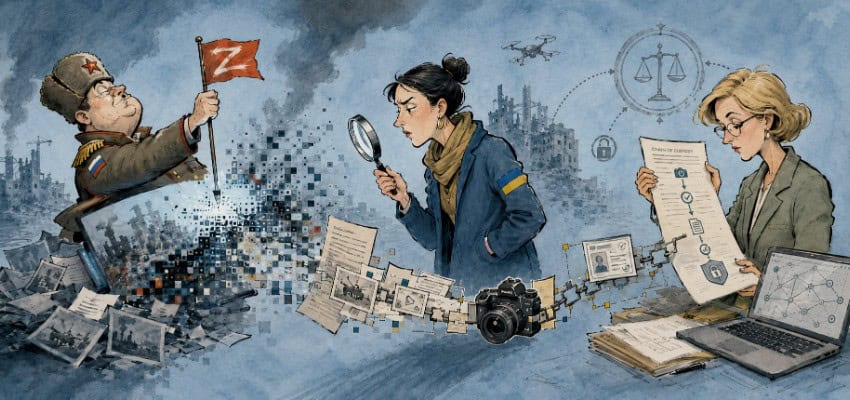
Editor’s Note: During the week of June 13, the Institute for the Study of War reported that Russia appeared to be using curated battlefield footage and possibly AI-generated flag-raising videos to exaggerate gains around Kostyantynivka, where Ukrainian commanders and ISW disputed Russian claims of control. That assessment emerged alongside two other developments with direct relevance for cybersecurity, data privacy, regulatory compliance, and eDiscovery professionals: U.S. export controls reportedly forced Anthropic to disable access to two frontier AI models worldwide, and British forces boarded a sanctioned Russian shadow-fleet tanker in the English Channel.
Together, these events point to a common operational challenge: proving what is real, preserving the records that support that proof, and maintaining continuity when critical AI capabilities become vulnerable to geopolitical action. Synthetic media that can distort a battlefield narrative can also complicate a data room, an investigation, or a contested evidentiary record. Content provenance standards, the proposed Federal Rule of Evidence 707, and NIST-aligned digital-evidence practices increasingly favor documented, often cryptographically supported, chains of custody.
For practitioners, the article highlights three areas to watch in the second half of 2026: how courts treat authentication challenges involving AI-generated media, how provenance metadata becomes part of discovery and information governance workflows, and how organizations build redundancy against sudden AI-access disruptions.
Content Assessment: When the flag may be fake: Ukraine's June war and the new burden of proof
Information - 93%
Insight - 94%
Relevance - 94%
Objectivity - 92%
Authority - 93%
93%
Excellent
A short percentage-based assessment of the qualitative benefit expressed as a percentage of positive reception of the recent article from ComplexDiscovery OÜ titled, "When the flag may be fake: Ukraine's June war and the new burden of proof."
Industry News – Geopolitics Beat
When the flag may be fake: Ukraine’s June war and the new burden of proof
ComplexDiscovery Staff
The most consequential weapon on the Ukrainian front this week may not have been a missile. It was a video of a flag.
On June 15, the Institute for the Study of War reported that Russia appears to be running a sophisticated information operation that uses what analysts assess may be artificial-intelligence-generated footage of flag raisings to manufacture proof of battlefield gains it has not made. The clips show Russian soldiers planting flags on the edges of Kostyantynivka, a fortress city in Donetsk Oblast. The Russian Defense Ministry claimed seizures to match. Ukrainian commanders on the ground told a different story, and ISW said it has reason to believe the videos themselves are synthetic.
For anyone who builds a living on the integrity of records, that is the story behind the story. The same digital tools that can fabricate a flag raising can fabricate a contract, a deposition exhibit, a surveillance clip, or a board minute. The Ukraine war has become a live demonstration of a problem cybersecurity, information governance, and eDiscovery teams will spend the next decade solving: how do you prove what is real when production is cheap and provenance is rare?
A synthetic battlefield, and a synthetic record
ISW’s June 15 assessment is careful in its language, and that care matters. Analysts wrote that the flag-raising videos “may be” AI-generated, consistent with earlier Russian operations that used synthetic footage to claim advances. Ukrainian 19th Army Corps Commander Brigadier General Alexander Bakulin said Russian units had already reported up the chain of command that they had taken Kostyantynivka, then attacked to make the false reports true. He estimated 93 to 153 Russian infiltrators in the city, well below the figures Russian channels were promoting, a range that independent Ukrainian outlet Hromadske, cited by ISW, roughly tracked in its frontline reporting.
The disputed videos were not independently authenticated for this article. The assessment that the footage may be synthetic rests on ISW’s June 15 analysis and the public claims described in that report, not on a forensic finding. What is better established is that Russian sources have used curated footage and information operations to exaggerate their presence and gains around the city.
That broader pattern does not depend on ISW alone. Ukraine’s Center for Countering Disinformation, citing findings from the deepfake-detection firm Sensity AI, has reported over 1,000 synthetic videos forming part of what it calls a “narrative kill chain,” a modular campaign tailored to soldiers, civilians, and Western audiences, according to coverage by the state news agency Ukrinform. Independent outlets including Euronews and United24 Media have documented AI-made “victory videos” and deepfakes of Ukrainian troops timed to symbolic dates. The Kostyantynivka clips are the newest instance of a phenomenon that several parties, not one analytical shop, have tracked, which is the point for practitioners: synthetic media at scale is now a standing feature of the information environment, not an anomaly.
The mechanics are familiar to any litigator who has fought over a contested file. A claim is made, an artifact is produced to support it, and the burden shifts to the other side to disprove the artifact. When the artifact is a convincing fake, the cost of rebuttal explodes. Multiply that across a war, an election, or a document review, and authentication stops being a back-office task and becomes the main event.
That shift is already reaching the courtroom. Content-provenance work built on the C2PA standard moved from pilot toward infrastructure across 2025 and 2026, with Leica shipping native in-camera content credentials and Sony and Canon adding signing to select models through firmware, all using hardware-rooted keys at the moment of capture. The rollout has been uneven. Nikon added C2PA to its Z6 III in August 2025, then suspended its authenticity service weeks later after a security vulnerability and revoked the related certificates, a sign that provenance tooling is itself a target. Proposed Federal Rule of Evidence 707, paired with NIST digital-evidence guidance, may increasingly shape litigation planning and evidentiary practice around a documented, often cryptographically anchored, chain of custody from the frame a camera records to the exhibit a lawyer offers. The rule remains a proposal, advancing through the federal rule-making process toward a possible effective date no earlier than December 2027, and it creates no present courtroom obligation, but litigators are already factoring it into how they build and challenge digital exhibits. Practitioners who want to stay ahead should start treating provenance metadata as discoverable now, building intake workflows that preserve content credentials instead of stripping them, and documenting how synthetic-media screening was performed.
The strike data and the fight over what it means
The week’s kinetic record was brutal and well sourced. Ukraine’s Air Force reported that Russia launched about 70 missiles and 611 drones on the night of June 14 to 15, striking Kyiv, Dnipro and Kharkiv. Zelensky said the strikes killed at least 11 people and injured at least 53, and left 140,000 Kyiv residents without power. Internal Affairs Minister Ihor Klymenko reported a double-tap strike that killed five first responders in Kharkiv. The United Nations human-rights mission had already called May 2026 the deadliest month for Ukrainian civilians since April 2022.
Then came the dispute over the evidence. After strikes damaged the Kyiv-Pechersk Lavra and other cultural sites, the Russian Defense Ministry claimed a Ukrainian Patriot interceptor was responsible, and Foreign Ministry spokesperson Maria Zakharova said the West fabricated the accusation against Russia. Ukrainian Air Force spokesperson Colonel Yuriy Ihnat said investigators had already established that a Russian Geran-2 drone hit the site, and that Russian channels were exploiting stray Patriot fragments to muddy the record. This is information governance under fire: two parties, one event, competing artifacts, and a global audience asked to adjudicate in real time.
When the AI itself disappears
The conflict is also reshaping who gets to use advanced AI at all, and that has direct operational weight for security and legal teams. On June 12, the U.S. government issued an export-control directive that forced Anthropic to disable its two most capable models, Fable 5 and Mythos 5, for every customer worldwide. The directive itself was not made public, which leaves its full legal basis and the underlying technical evidence outside public view. The company said the order cited national security and described it as based on what officials characterized to them as evidence of a narrow potential jailbreak. Reuters reported that experts feared the Mythos line, in the wrong hands, could accelerate sophisticated cyberattacks against sectors such as banking that run on aging, interconnected systems.
The lesson for practitioners is not about one vendor. It is about dependency. A capability that anchors a review workflow or a threat-detection pipeline on Friday can vanish by directive on Monday, with no notice and no appeal. Teams that hard-wire a single frontier model into critical processes are carrying a geopolitical risk they have not priced. The hedge is unglamorous: maintain model redundancy, keep an exit path to a second provider, and confirm that data-residency and export-control terms in vendor contracts can survive a sudden supported-regions change.
The quieter cyber front
Underneath the missile counts runs a steady contest over infrastructure and money. Ukraine struck a chemical plant in Tula Oblast and an oil depot in Yaroslavl Oblast that holds strategic fuel reserves, and footage showed a Ukrainian drone destroying a Russian electronic-warfare system built to jam Starlink. On June 14, British forces boarded the sanctioned shadow-fleet tanker Smyrtos in the English Channel, the first UK interdiction of its kind; the Defence Ministry said the shadow fleet carries 75 percent of Russia’s sanctioned oil.
The cyber picture is more textured than a single upward arrow. The Computer Emergency Response Team of Ukraine averaged about 15 incidents a day through 2025 and tracked over 150 threat clusters, with Russia the primary source, according to Ukraine’s State Special Communications Service. Critical incidents actually fell in the second half of 2025 as defenses matured, with high-level incidents down 17 percent, even as the Russia-linked Sandworm group escalated destructive data-wiping attacks on government, energy, logistics, and grain systems. The takeaway for defenders is not that the threat eased; it is that volume metrics and severity moved in opposite directions. Analysts tracking hybrid operations across Europe also logged sabotage against rail and logistics tied to Ukraine-bound supply chains.
For compliance officers, the through-line is sanctions exposure and data integrity. Every interdicted tanker and every blacklisted entity expands the screening obligations that sit inside corporate data, and every contested strike expands the universe of records that may someday need to be authenticated, preserved, and produced.
What to carry into the second half of 2026
The pattern across June 13 to 15 is consistent. Force is applied, a record of that force is contested, and synthetic media raises the cost of telling truth from fabrication. Cybersecurity teams should treat AI-generated disinformation as an active threat vector, not a future one. Information-governance leaders should make provenance capture a default, not an upgrade. eDiscovery professionals should assume that authentication challenges to audio, video, and images will become routine, and build the metadata discipline to meet them before opposing counsel forces the issue.
The war is showing every regulated industry where the ground is moving. The flag in the video may be fake. The obligation to prove what is real is not. When your organization is handed a piece of digital evidence next quarter, will you be able to prove it is genuine, or only hope no one asks?
News sources
- Russian Offensive Campaign Assessment, June 15, 2026 (Institute for the Study of War)
- Russian Offensive Campaign Assessment, June 14, 2026 (Institute for the Study of War)
- Russian Offensive Campaign Assessment, June 13, 2026 (Institute for the Study of War)
- US asks Anthropic to block global access to top AI models: Why it matters (Al Jazeera)
- UK forces intercept Russian shadow fleet vessel for the first time (GOV.UK, Ministry of Defence)
- Surveillance footage on trial: content provenance, the deepfake authentication gap, and FRE 707 (IntelliSee)
- The war on deepfakes: how C2PA integration is fighting back (TechSpective)
- Cyber threat overview and defense strategies in 2025: CERT-UA’s experience (State Special Communications Service of Ukraine)
- Safeguarding the courtroom from AI-generated evidence: Federal Rule of Evidence 707 (Nelson Mullins)
- Every camera that supports C2PA content credentials in 2026 (Lumethic)
- Nikon Authenticity Service: C2PA content credentials solution (Nikon)
- Russia expands AI disinformation into cognitive warfare (Ukrinform, citing the Center for Countering Disinformation and Sensity AI)
- Russia turns to AI-made victory videos as battlefield gains stall (United24 Media)
- Deepfakes of frontline Ukrainian soldiers aim to undermine morale (Euronews)

Assisted by GAI and LLM Technologies
Additional reading
- When the drone war reaches the reactor fence: Ukraine and the cyber-physical front
- When the refineries burn: Ukraine’s strikes turn Russia’s energy backbone into a cautionary tale
- The night Ukrainian drones exposed gaps in Moscow’s defenses and state TV gave it 60 seconds
- From warning to funding: Russia’s expanding media machine and the risk signals ahead
- Invisible by design: NATO’s 2026 cognitive warfare paper and the crisis of discovery
- When Your Legal Tech Vendor Gets Breached: DocketWise Incident Exposes 116,666 Immigration Records and a Profession’s Blind Spot
- The DOJ’s Cyber FCA Playbook Is Working as Enforcement Triples and Shows No Signs of Slowing
- FTC’s OkCupid Action Reframes AI Training Data as a Consumer Protection Issue
- White House AI Framework Signals New Compliance Stakes for Legal, Cybersecurity, and eDiscovery
- The Gatekeeper’s Key: How the Conformity Assessment Unlocks the EU AI Market
Source: ComplexDiscovery OÜ
ComplexDiscovery’s mission is to enable clarity for complex decisions by providing independent, data‑driven reporting, research, and commentary that make digital risk, legal technology, and regulatory change more legible for practitioners, policymakers, and business leaders.