
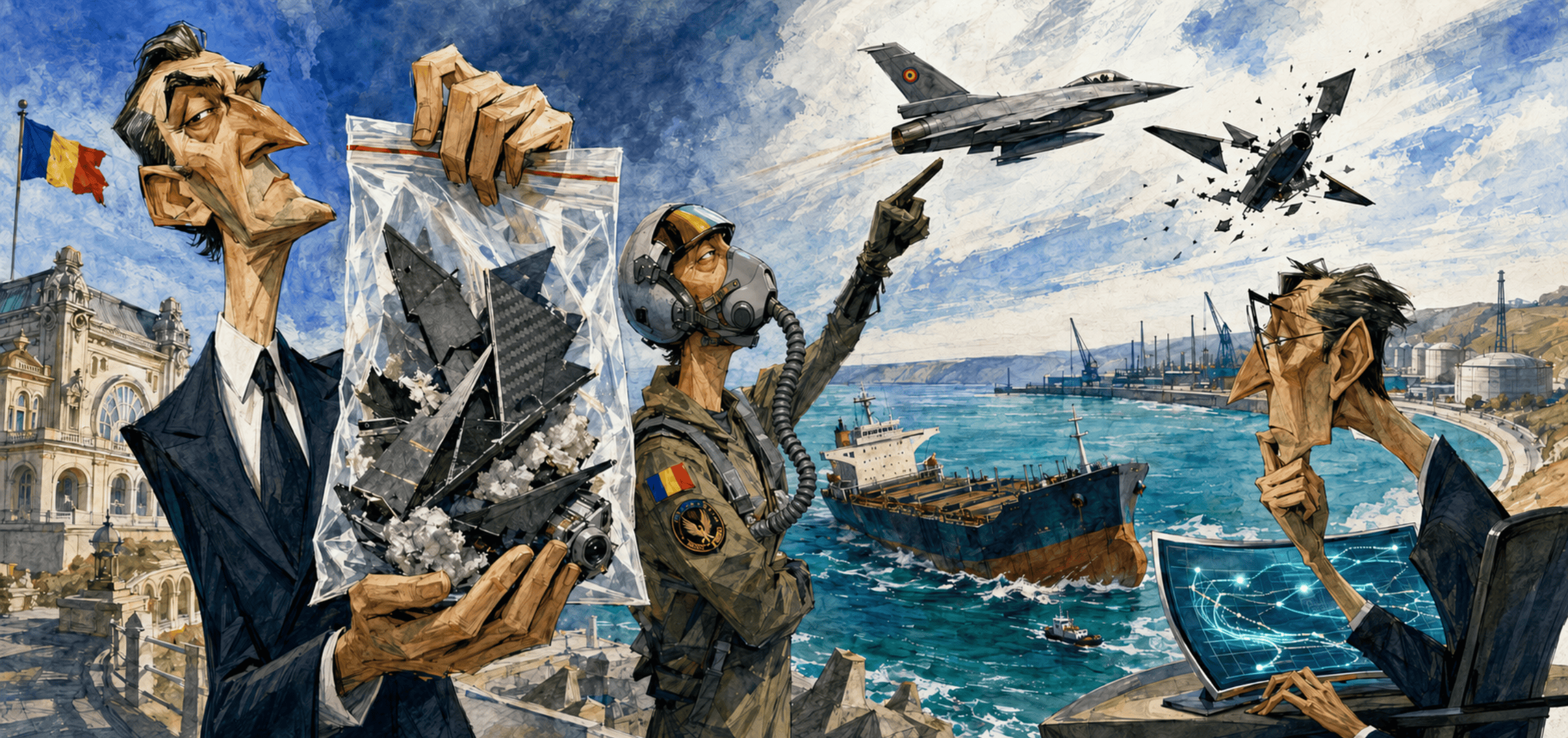
Editor’s Note: Three drones came down on Romanian soil and water in three days last week, and only the first left anything a court can hold. Fragments recovered near Padina became a criminal file at the Ploiești Court of Appeal and, three days later, an exhibit shown to Russia’s ambassador. Searches after the other two came up empty.
For cybersecurity, data privacy, regulatory compliance and eDiscovery professionals, the week reads as a working brief. A coal carrier was damaged in Romania’s exclusive economic zone with no cause established, and one casualty at sea may engage flag state and coastal state proceedings along with a chain of commercial counterparties, each on its own contractual clock. Satellite navigation interference across the same waters makes position-derived records contestable and raises the value of radar and raw receiver data. Sanctions teams now have a Russian advisory calling Moscow’s own economic zone unsafe. Moscow also denies sending anything.
Track three threads: whether the Ploiești file moves from an act to a person, whether either damaged hull gets a cause finding, and how underwriters price a casualty no authority will attribute.
Content Assessment: When an air defense engagement becomes a criminal case file
Information - 93%
Insight - 92%
Relevance - 90%
Objectivity - 93%
Authority - 94%
92%
Excellent
A short percentage-based assessment of the qualitative benefit expressed as a percentage of positive reception of the recent article from ComplexDiscovery OÜ titled, "When an air defense engagement becomes a criminal case file."
Industry News – Geopolitics Beat
When an air defense engagement becomes a criminal case file
ComplexDiscovery Staff
The war’s newest exhibit is a handful of foam and carbon fiber, and it is sitting in a Romanian prosecutor’s file.
Ten to 15 fragments, the largest about 20 to 30 centimeters, came down on farmland near Padina in Buzău County on the morning of Friday, July 24, pulverized on impact and carrying no markings of any kind. A Romanian F-16 put them there. Three days later they were carried into the Foreign Ministry in Bucharest and shown to Russia’s ambassador.
Romanian fighters shot down drones over national territory and territorial waters on three consecutive mornings, July 24 to July 26. A coal carrier bound for the Odesa region was damaged inside Romania’s exclusive economic zone. Russia’s largest Black Sea oil terminal stopped loading tankers for five days, and Moscow told shipping across its own economic zone that navigation was no longer safe. For professionals who work on evidence, sanctions screening and cross-border compliance, that combination is the week’s actual news, and it will outlast the week.
Eighty-three minutes over Romania
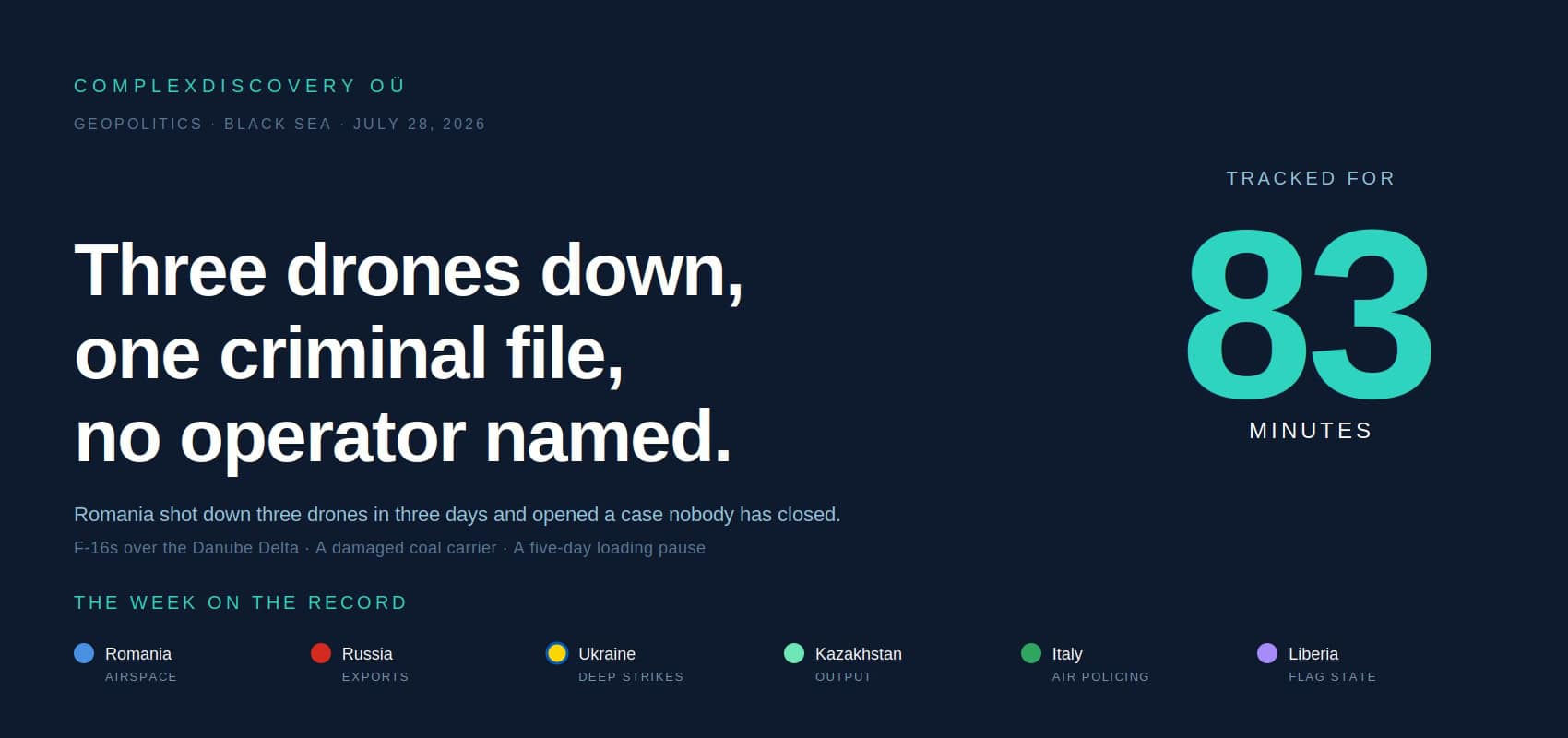
Radar picked up an aerial target at 9:39 a.m. about 20 kilometers east of Sulina, according to the Romanian Ministry of National Defence. The track ran inland along a Sulina to Brăila to Fetești to Buzău line. Two Italian Air Force Eurofighter Typhoons scrambled at 9:48 a.m. from the 57th Air Base at Mihail Kogălniceanu under NATO air policing, the alliance’s standing peacetime watch over allied skies. Two Romanian F-16s from the 86th Air Base at Fetești followed at 10:56 a.m. At 11:02 a.m. one of them destroyed the drone over unpopulated ground near Padina.
The object had been tracked for 83 minutes and crossed far inland before anyone brought it down. While it flew, authorities pushed warnings to the public in Tulcea and Brăila counties over RO-Alert, the national system that sends emergency text messages to every mobile phone in an affected area. An air-to-air missile fired during the intercept missed. The ministry later located its crater and remains at Tătaru, in neighboring Brăila County, on unpopulated ground with no casualties, and NATO said an investigation was under way.
Romania had never shot down a drone in its own airspace before that morning. Romanian F-16s had downed one abroad, over Estonia on May 19, flying from Lithuania under NATO Baltic Air Policing, in an engagement Estonian authorities assessed as involving a drone likely of Ukrainian origin that had crossed in from Russian airspace. That distinction is worth holding onto, because it turns out to be the shape of the whole week.
Saturday’s drone appeared on radar at 8:22 a.m. and was destroyed at 8:34 a.m. about 9.6 kilometers west of Sfântu Gheorghe, in the Danube Delta. Sunday’s was detected at 9:29 a.m. roughly 25 kilometers southeast of Sulina, crossed into national airspace at 10:08 a.m. and was downed five minutes later, 12 kilometers northeast of Sulina inside territorial waters, with another debris warning across Tulcea County. “A new drone was shot down this morning, at 10:13, by an F-16 aircraft of the Romanian Air Force, over the territorial waters of Romania, in the Sulina-Chilia area,” President Nicușor Dan said.
The Defence Ministry counts 33 incursions of Romanian airspace by Russian drones since Feb. 24, 2022, and 50 situations in which drone fragments or intact drones were found on Romanian soil. Eighteen unauthorized incursions fell in 2026 alone. What changed last week was the response: three engagements instead of three escorts. What did not change was how little of it could be picked up afterward.
Five descriptions of the same object
Here is the detail that should interest anyone who builds cases for a living. Five Romanian sources described the July 24 drone that same day, and no two used the same words.
The Defence Ministry’s English release called it an unmanned aerial vehicle that had violated national airspace, used aerial target for the radar contact, and headlined it simply as a drone. Three registers, all generic, none naming a maker or an owner. At a briefing, a ministry general said the pilots had visually reported a Shahed type threat, a reference to the Iranian-designed one-way attack drone that Russia also builds and fields under its own designation, the Geran-2. The Prosecutor’s Office attached to the Ploiești Court of Appeal said the identified drone “was a Shahed device and was shot down by an F-16 aircraft piloted by a Romanian airman.” Leonard Dimian, prefect of Buzău County and the national government’s appointed representative there, told reporters the recovered material appeared to be graphite-treated polystyrene or carbon fiber, unmarked, with the single largest element 20 to 30 centimeters across. Dan called it a “Shahed model, used by the Russian Federation in its war of aggression against Ukraine.”
Note the ladder. The military named a category. The pilots named a silhouette. The prosecutors named a type. The prefect named a material. Only the head of state named an author.
That gap is not sloppiness. It is the difference between political attribution, which moves in hours, and forensic attribution, which moves at the speed of a docket and eventually has to survive cross-examination.
Provenance is not authorship
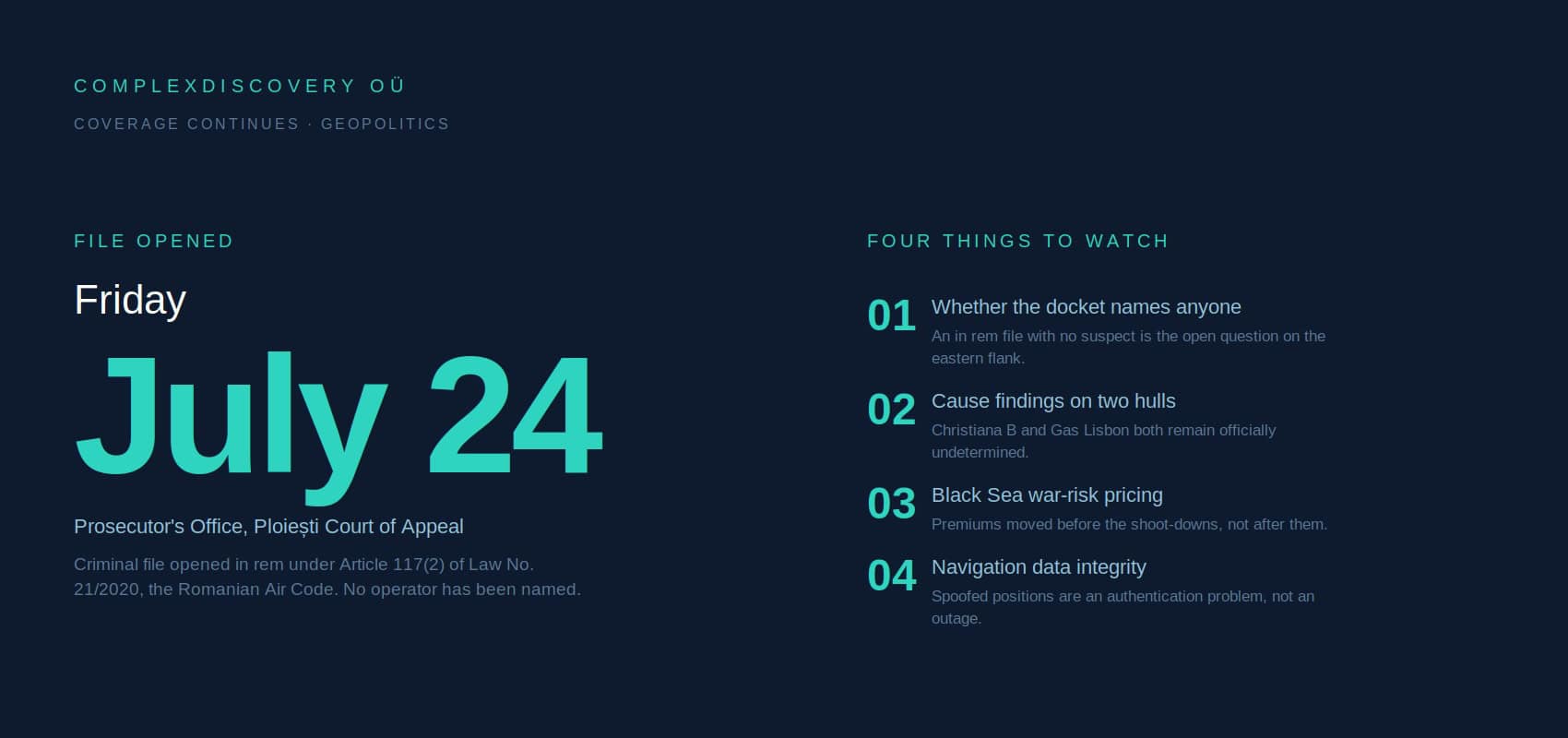
The prosecutors opened their case the same day, under Article 117, paragraph 2 of Law No. 21/2020, the Romanian Air Code, for operating an aircraft in a prohibited area. They opened it in rem, a Latin term meaning the case proceeds against the act itself rather than against any named person, because no suspect has been identified. A file that stays in rem is a file that has evidence but no defendant.
By Monday the wreckage had yielded more. The Foreign Ministry said on July 27 that the prosecutors’ examination had officially confirmed the components were of Russian provenance, and Radu-Dinel Miruță, the deputy prime minister and defense minister, told broadcaster B1 that the case prosecutor had confirmed the drone was of Russian origin. On July 28 Țoiu went further: “The drone belongs to them, the responsibility lies with them, Romania does not accept this.” Neither prosecutor’s office issued its own public statement naming a responsible party, and the file has not been reported as moving against a named person.
Hold those two findings apart, because the distance between them is the entire professional lesson. The reported finding establishes the provenance of the recovered assembly. It does not necessarily establish where every component was manufactured, who launched the aircraft, or with what intent. Provenance is a forensic question, and laboratory examination can inform it. Authorship is a different question, with a different evidentiary burden, and no laboratory can answer it alone. Any practitioner who has watched a forensic report get stretched past what it actually proves will recognize the gap immediately.
The diplomatic track did not wait for it to close. On July 27, Foreign Minister Oana Țoiu summoned Russian Ambassador Vladimir Lipaev, showed him the fragments, declared an embassy staff member persona non grata, the formal withdrawal of a diplomat’s welcome, with five days to leave, and recalled Romania’s own ambassador from Moscow for consultations. The ministry lodged what it called the firm protest of the Romanian side against these illegal and irresponsible actions, saying it was absolutely inadmissible and intolerable for the Russian Federation to continue violating Romanian airspace, which is equally NATO and European Union airspace. Romania did not invoke Article 4 of the North Atlantic Treaty, the clause under which any single ally can call the alliance into consultation when it believes its security is threatened, though Țoiu said any ally can request it at any time. Col. Martin O’Donnell, a spokesperson for NATO’s Supreme Headquarters Allied Powers Europe, put the alliance line plainly: “As we continue to prove, NATO is constantly on the watch and prepared to defend itself from any threat.”
Moscow rejected all of it. Russia “has never sent and is not sending combat unmanned aerial vehicles against targets on Romanian soil,” the Russian Embassy in Bucharest said on July 27, calling the speculation “completely without any basis” and the expulsion “utterly unsubstantiated,” and saying it would not remain without response. Lipaev called the accusations a new propaganda staging. The embassy offered no supporting evidence; its statement is the only public account in the record contesting the Romanian findings.
The other two engagements gave investigators almost nothing to hold. Ministry teams suspended their search for Saturday’s wreckage in difficult delta terrain, and by Sunday evening ground and air crews reported they had identified no fragments. Sunday’s drone came down over territorial waters, and Coast Guard boats were still searching when the week ended. No separate case file has been reported for either. Of three shoot-downs, one produced an evidence file.
A coal ship, an economic zone and no cause
Overnight July 23 into July 24, in roughly the same water, the Liberian-flagged bulk carrier Christiana B was damaged in cargo hold No. 6 about 22 nautical miles southeast of Sfântu Gheorghe. No official statement has said the hull was breached. She had loaded coal at Norfolk, Virginia, and was running for the Odesa region.
Where she was damaged matters. The position sits inside Romania’s exclusive economic zone, the belt of sea reaching up to 200 nautical miles from shore where a coastal state holds sovereign rights over resources but not the full sovereignty it exercises inside its 12-nautical-mile territorial sea. Romania could shoot down an aircraft over Padina. A ship damaged 22 miles out is a different legal animal, and the difference will shape every claim that follows.
Romania’s Department for Emergency Situations said preliminary assessments suggested the vessel may have been affected by a naval mine or a maritime drone, and stressed the finding was provisional. Rescue craft SAR Apollo and SAR Artemis put to sea from Constanța alongside an aviation inspectorate helicopter. Nobody was hurt, the crew declined evacuation, and the owner asked for repairs at Constanța or Varna.
She was the second casualty in that water in four days. Overnight July 20 into July 21, the liquefied petroleum gas carrier Gas Lisbon, Liberian-flagged and Turkish-operated, caught fire after an explosion roughly 20 nautical miles off the Romanian coast while carrying propane from Alexandria toward Reni, in Ukraine. Three of her 17 crew were injured, and a 45-year-old Filipino crew member died of his injuries on July 23. Dan said the incident was most likely part of Russia’s war of aggression and that authorities would establish circumstances, causes and responsibilities. As of this writing, no authority has determined a cause for either vessel.
Count what those two casualties potentially set in motion. At least two national jurisdictions: a possible Liberian flag state inquiry, since a ship answers to the country whose flag she flies, and a Romanian coastal state investigation. Then a chain of commercial relationships that is not a jurisdiction but behaves like one, since each link carries its own paperwork: owners, charterers, cargo interests on both hulls, any applicable protection and indemnity club, the mutual association through which owners and charterers cover third-party liabilities, and any war-risk underwriter on risk. Notice obligations vary by contract rather than running on one clock, which is precisely what makes them easy to miss. The file gets assembled long before anyone establishes cause, which is why voyage data, engine logs, position histories, bridge audio and damage survey photographs need preserving now, on a hold that assumes litigation rather than hopes against it.
Underwriters were repricing this water before any of it happened. S&P Global Commodity Insights reported on July 21 that the additional war-risk premium for shipping crude reached $2.1 a barrel on July 20, up from $2 on July 16, and that freight for Suezmax tankers, the largest class that can transit the Suez Canal fully laden, rose from $68.57 to $78.57 a tonne on the Novorossiysk to west-coast India run. Those are route-specific Platts assessments, not a general Black Sea number. Fotios Katsoulas, tanker research director at S&P Global, said heightened security risk should push owners toward higher freight requirements, higher war-risk insurance costs, or a smaller pool of willing tonnage. Contract teams should be pulling charterparties now and checking whether their force majeure and war-risk clauses are triggered by an attack, by hostile action, or by a cause nobody has determined. That last category is where both of these casualties will sit for some time.
When the position itself is contested
The cybersecurity dimension here is quieter than the shooting and harder to fix. Romania tracked the July 24 drone on military radar, which is why that timeline is unusually solid. Many civilian digital position records have no such backstop: they are derived from satellite navigation, and satellite navigation has been under sustained attack across this exact geography.
The threat has two shapes and they are not equivalent. Jamming denies the signal, and a receiver at least knows it is lost. Spoofing feeds the receiver counterfeit satellite signals so that it confidently computes a position that is wrong. Spire Global, analyzing satellite-collected aircraft telemetry from August 2024 through May 2025 in a report published in September 2025, documented persistent interference over the Black Sea and Romanian airspace, including a single monitoring cell over the Buzău region that captured data from as many as 399 aircraft during an October 2024 event. Civilian vessel tracking in the region has shown ships appearing inland, spinning in circles or drifting far off established routes. Spire’s analysts framed the risk in a line worth keeping: “In contested or congested airspace, false confidence in location is more dangerous than signal loss.”
For anyone who will later be asked to authenticate a track, a position report or a geolocated image from the Black Sea, that is the threat model. Integrity of the record, not availability of the signal, is the exposure, and it applies to satellite-derived data specifically rather than to every position claim. Radar tracks, visual observation and raw receiver logs are the corroboration that survives a challenge. Teams supporting maritime, aviation, energy or insurance clients should be capturing them contemporaneously, because a position resting on a single spoofable source may not withstand challenge without corroboration, and the other side has every motive to contest it.
Moscow warns vessels that navigation is unsafe
The commercial picture across the sea is no calmer. Sheskharis, the Transneft-owned terminal at Novorossiysk, stopped loading tankers on the morning of Tuesday, July 21, according to Bloomberg, which attributed the halt to drone threat; Rigzone’s account of the same reporting cited a combination of drone strikes and bad weather. The facility had averaged 650,000 barrels a day since the start of the year, close to a fifth of Russian seaborne crude exports, and Novorossiysk moves roughly a third of the country’s grain. A Suezmax departed Sheskharis on Sunday, July 26, closing a five-day gap. Bloomberg said Transneft, which owns the terminal, and the ship manager Universal Tanker Management did not immediately respond to its requests for comment. At the nearby Caspian Pipeline Consortium terminal, loadings stopped after drone attacks on civilian vessels on July 17 and July 19, and Kazakhstan cut production as storage filled: output at the Chevron-led Tengizchevroil venture fell from a July average near 925,000 barrels a day to 406,000 on July 22, a 56 percent drop, according to Reuters citing an industry source. Kazakhstan’s Energy Ministry called the cut a technological measure. CPC resumed loading on Monday, July 27.
Then came the striking part. In its weekly navigational bulletin on July 22, the Russian Defense Ministry warned all vessels inside Russia’s own Black Sea exclusive economic zone that navigation was unsafe because of Ukrainian aerial and maritime drones. Novorossiysk separately imposed a nightly navigation ban between midnight and 5 a.m. When the coastal state itself warns that navigation within the zone is unsafe, the disclosure carries commercial consequences well past the shipping desk, and sanctions teams should treat the warning as an indicator that could produce route substitution or additional ship-to-ship transfers, where cargo moves between vessels at sea rather than at a berth, rather than as a weather advisory.
Domestic strain showed elsewhere in the same week. Deputy Prime Minister Alexander Novak said in Omsk on July 25 that the gasoline export ban, due to expire July 31, would extend through the end of the year for producers and non-producers alike, with the diesel ban imposed July 8 lifted once the home market rebounds. The Bank of Russia cut its key rate a quarter of a percentage point, from 14.25 percent to 14 percent, on July 24, its tenth consecutive reduction, with annual inflation reported at 5.9 percent as of July 20. Ukrainian long-range strikes reached the Rostov-on-Don river port and oil facilities in Yaroslavl Oblast and Udmurtia on July 27, with the Udmurtia target over 1,300 kilometers from Ukrainian territory. Aleksandr Brechalov, head of the Udmurt Republic, described it as the most massive attack on his region in recent times.
Institutions follow weapons. Speaking to the Zvezda television channel on Navy Day, July 26, Adm. of the Fleet Aleksandr Moiseyev, commander in chief of the Russian Navy, said the Northern Fleet had stood up its first unmanned systems regiment on July 1, built from two divisions of uncrewed surface vessels and one of uncrewed underwater systems, with a second regiment planned for the Pacific Fleet in 2027. A 500-ton uncrewed vessel for underwater search is under construction. “It is already under construction, and it will become the first such vessel,” Moiseyev said, in the rendering carried by Russian state media. “It will lay the foundation for the further development of uncrewed systems.”
Ukraine reached that conclusion first and has spent three years proving it in the Black Sea. Analysts at the Institute for the Study of War have tracked the daily arithmetic of both campaigns since 2022, and the structural point is simpler than any single day’s tally: what began as improvisation is now a table of organization, a procurement line and a career path on both sides.
Romania is building the other half of the equation. The Defence Ministry said in June that Merops, a US-supplied counter-drone system it describes as based on artificial intelligence algorithms and designed to detect, track and neutralize small low-altitude aerial targets, had been fully operationalized and integrated into the national air defense architecture. The ministry has not said whether Merops played any part in last week’s engagements, all three of which are reported as F-16 intercepts with air-to-air missiles. A standing detection layer could identify more incursions and, when engagements follow, produce additional searches, debris fields and potential evidence, on a coastline where last week two searches out of three came up empty.
What gets built next, and what the record must carry
The professional work here is unglamorous and immediate. Trade compliance teams should re-baseline any counterparty routing through Novorossiysk or CPC and prepare for the possibility that cargo documentation lags operational changes. Information governance teams supporting shipping, energy, agriculture and insurance clients should map preservation duties across any flag state or coastal state proceeding and the relevant commercial relationships before counsel asks, because an unattributed incident can generate records across several of them at once, on clocks that do not run together. Security teams should treat navigation data integrity as a discovery problem, not only an operations problem. And everyone drafting or reading a forensic conclusion this year should mark the line between the provenance of an assembly and the identity of whoever sent it.
Then watch the Ploiești docket. A NATO member has taken an incident that would ordinarily be handled as a military and diplomatic matter and routed it through an ordinary criminal statute about flying in a prohibited area. Whether that file ever moves from an act to a person will tell you how much evidentiary weight a shoot-down can actually carry, and whether prosecution becomes a usable instrument on the alliance’s eastern flank or stays primarily declaratory.
Which brings this back to the evidence bag. Unmarked fragments recovered from a field in Buzău County made it into a criminal docket, a diplomatic protest and an expulsion order inside 72 hours. Officials described their apparent composition and later attributed their provenance to Russia. The file still names no one who sent them, Moscow denies sending anything, and the other two engagements had yielded no recovered material as of publication. When the objects crossing a border carry no flag, no serial plate and no pilot, what standard of proof should a democracy demand before it calls a violation by its author’s name?
News sources
- Drone Neutralized by Romanian Air Force Pilot in National Airspace (Romanian Ministry of National Defence, via GlobalSecurity)
- Drone shot down in Buzau: Prosecutor General’s Office says the drone was a Shahed type (Stiripesurse)
- Romania scrambles F-16 jets to shoot down a suspected Russian Shahed type drone, marking the fourth recent violation of NATO airspace (Fortune)
- Romania summons Russian ambassador, expels embassy staffer after shooting down three drones (Meduza)
- Oana Toiu, message to Russia: The drone belongs to them, the responsibility lies with them (AGERPRES)
- Russian Embassy in Bucharest: Groundless expulsion of diplomatic mission member will not go unanswered (AGERPRES)
- New Black Sea incident: Liberia-flagged vessel damaged, possibly by drone (AGERPRES)
- Sailor aboard LPG carrier Gas Lisbon dies of his wounds (The Maritime Executive)
- Major Russian Black Sea Oil Terminal Halts Operations Amid Ukrainian Drone Threat (The Moscow Times)
- Russia’s Novorossiysk Resumed Crude Loadings After Days of Halt (gCaptain, reporting Bloomberg)
- Black Sea tanker rates jump on ship attacks, but outlook remains uncertain (S&P Global Commodity Insights)
- Russia To Build Uncrewed Vessel For Submarine Detection And Expand Naval Drone Units (Militarnyi)
- GNSS interference report: Russia, Part 4 of 4: Black Sea and Romanian airspace (Spire Global)
- Russian Offensive Campaign Assessment, July 26, 2026 (Institute for the Study of War)

Assisted by GAI and LLM Technologies
Additional reading
- The week the war reached Russia’s e-commerce supply chain
- The three silent hours: How Russia’s cyber war targets Ukraine’s newsrooms
- Confirmed versus claimed: reading the gap in Russia’s June offensive
- When the flag may be fake: Ukraine’s June war and the new burden of proof
- When the drone war reaches the reactor fence: Ukraine and the cyber-physical front
- When the refineries burn: Ukraine’s strikes turn Russia’s energy backbone into a cautionary tale
- The night Ukrainian drones exposed gaps in Moscow’s defenses and state TV gave it 60 seconds
- From warning to funding: Russia’s expanding media machine and the risk signals ahead
- Invisible by design: NATO’s 2026 cognitive warfare paper and the crisis of discovery
- When Your Legal Tech Vendor Gets Breached: DocketWise Incident Exposes 116,666 Immigration Records and a Profession’s Blind Spot
- The DOJ’s Cyber FCA Playbook Is Working as Enforcement Triples and Shows No Signs of Slowing
- FTC’s OkCupid Action Reframes AI Training Data as a Consumer Protection Issue
- White House AI Framework Signals New Compliance Stakes for Legal, Cybersecurity, and eDiscovery
- The Gatekeeper’s Key: How the Conformity Assessment Unlocks the EU AI Market
Source: ComplexDiscovery OÜ

ComplexDiscovery’s mission is to enable clarity for complex decisions by providing independent, data‑driven reporting, research, and commentary that make digital risk, legal technology, and regulatory change more legible for practitioners, policymakers, and business leaders.