
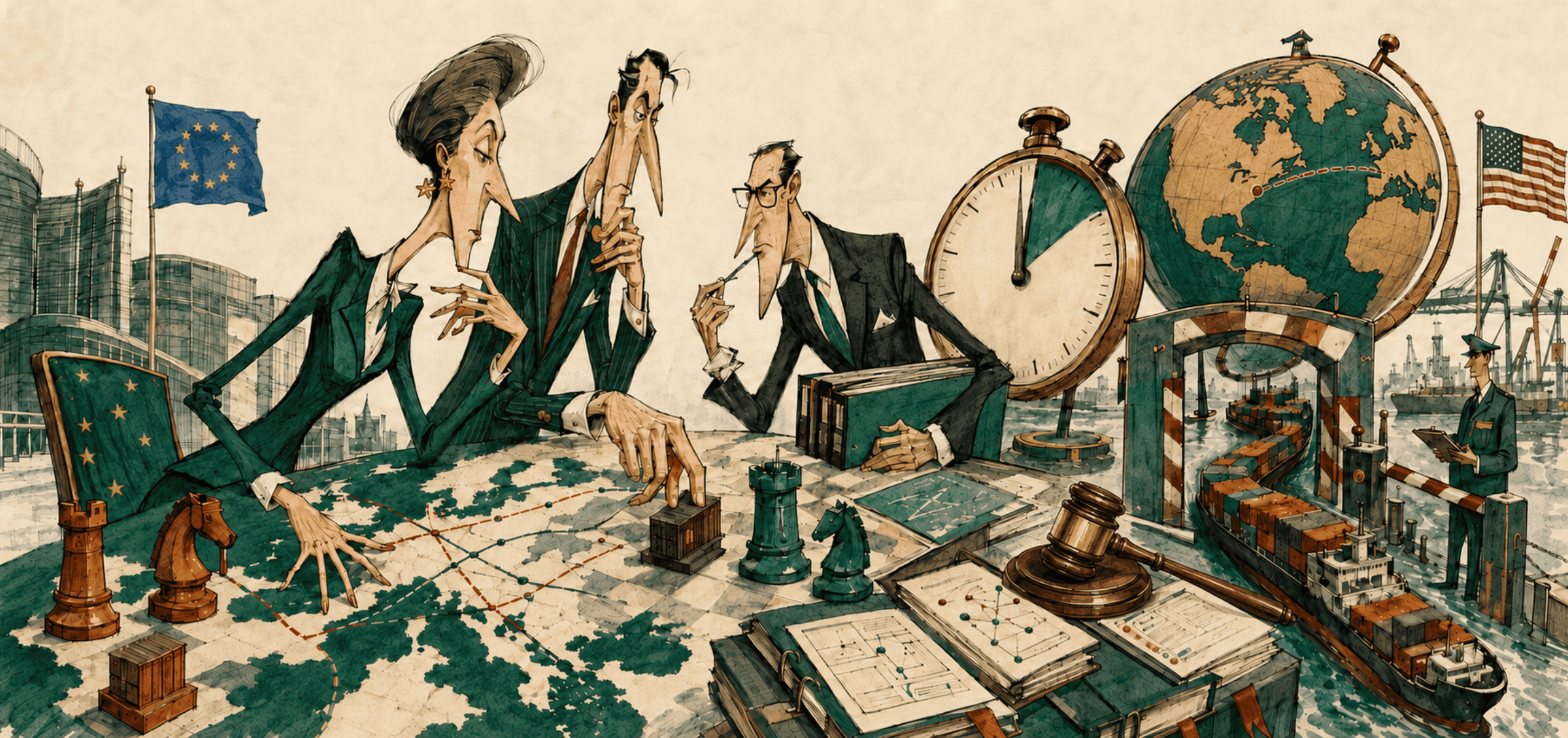
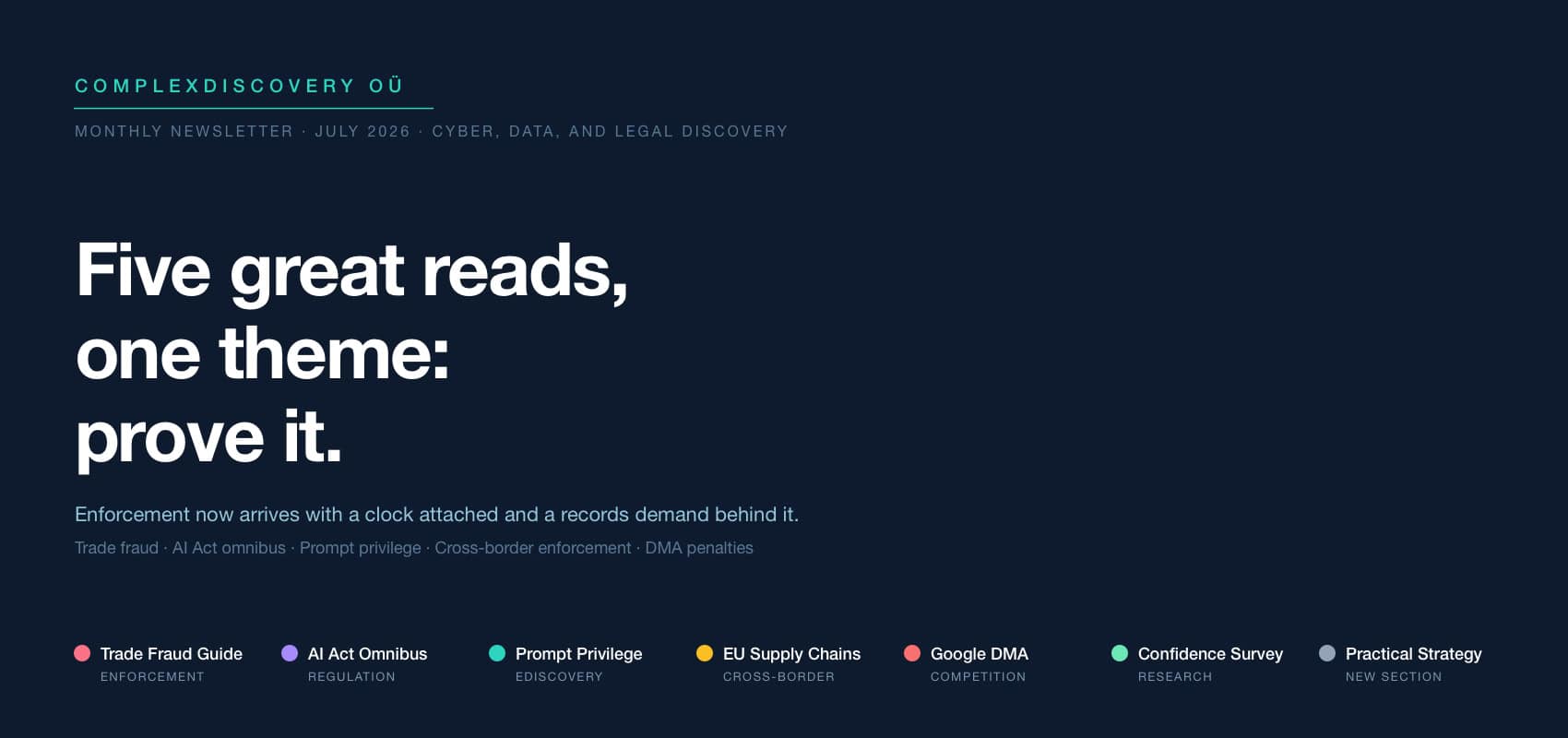
Editor’s Note: July’s Five great reads stories share a single mechanism: enforcement now arrives with a clock attached and a records demand behind it. A joint federal task force crossed the billion-dollar mark and published a guide announcing that claimed ignorance of a supply chain is no longer a defense. Brussels rewrote the AI Act’s compliance calendar while accelerating a new prohibition onto a faster track. New scholarship argued that the prompts attorneys refine inside generative AI review carry their mental impressions and deserve a zone of privacy. American customs enforcement reached across the Atlantic into European supply chains just as Europe’s own anti-fraud machinery converged on the same conduct. And a €890 million penalty package gave the world’s largest search company sixty days to bring its rankings into compliance—with retained configurations and versioned logs likely among the evidence fairness will be judged by. Across all five, oversight is moving from what systems do to what organizations can prove, on specific dates, with records they thought to keep.
This month’s Industry research puts numbers behind the mood: the 1H 2026 eDiscovery Business Confidence Survey finds confidence cooling sharply even as revenue commitment holds—with roughly three in ten AI-deploying respondents reporting emerging or absent governance. Lagniappe follows the money: nine M&A deals organized around two themes, a decade of second-request data pointing toward a heavier FY2026, June’s HSR filings running well ahead of last year’s pace, and European investors weighing a strong pipeline against a capital gap at home. July also introduces Practical strategy, a new section devoted to practical business thinking—this month spanning the research on job change and what it costs, the conversation that is never about work-life balance, Clausewitz’s center of gravity applied to company strategy, the unanimous launch review as a warning sign, and an Oxford-style tutorial on why business plans fail. Together they trace a single discipline: knowing what you can prove, and what you have quietly stopped doing.
Content Assessment: Five great reads on cyber, data, and legal discovery for July 2026
Information - 93%
Insight - 92%
Relevance - 95%
Objectivity - 93%
Authority - 94%
93%
Excellent
A short percentage-based assessment of the qualitative benefit expressed as a percentage of positive reception of the recent article from ComplexDiscovery OÜ titled, "Five great reads on cyber, data, and legal discovery for July 2026."
Industry Newsletter
Five great reads on cyber, data, and legal discovery for July 2026
ComplexDiscovery Staff
Click on the links to read the complete article.
The billion-dollar paper trail
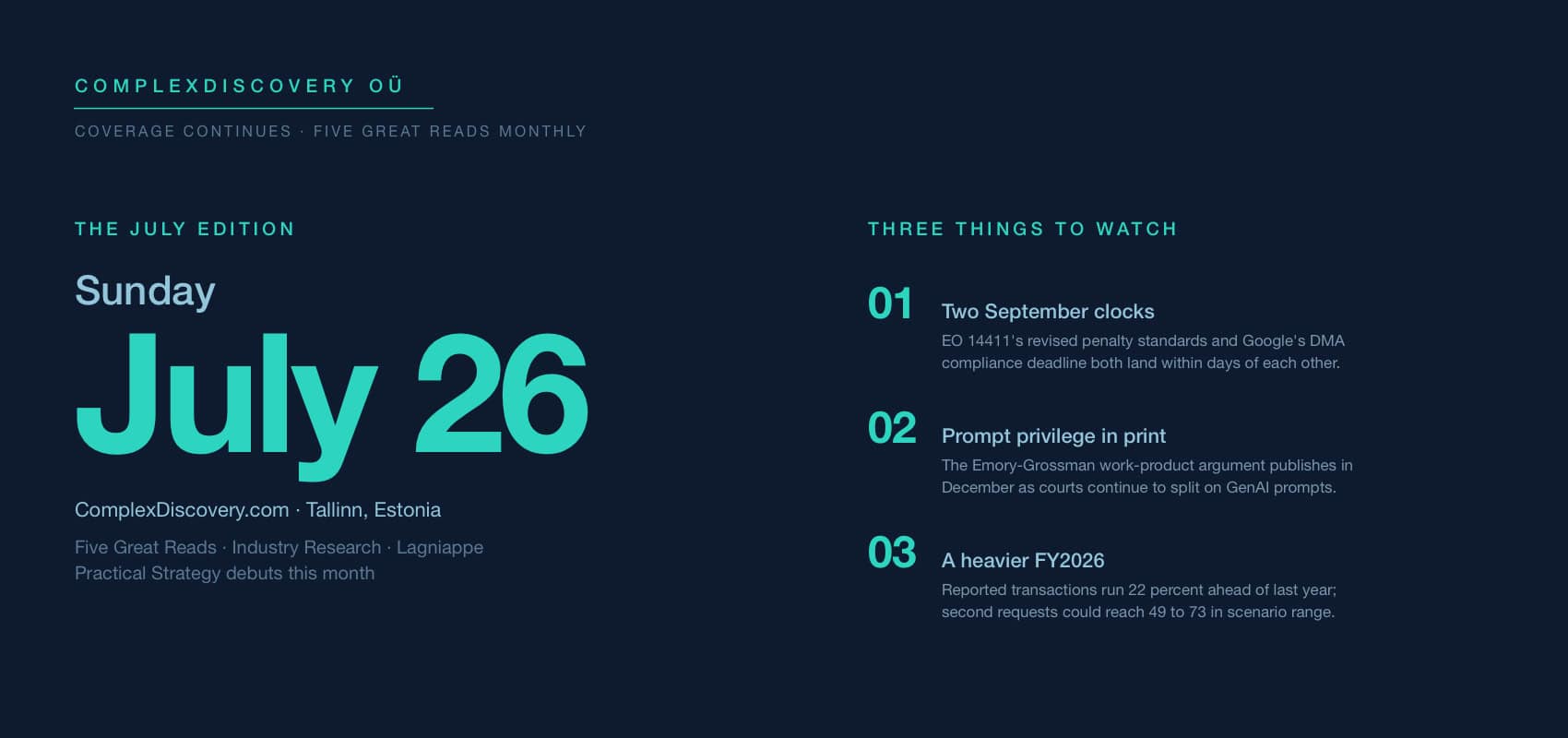
DOJ and DHS issue trade fraud guide as task force tally exceeds $1 billion reports on the July 14 release of a 31-page Resource Guide to Trade Fraud Enforcement as the joint DOJ-DHS Trade Fraud Task Force announced a tally exceeding $1 billion in under a year. The announced tally includes recoveries, penalties, forfeitures, and publicly charged losses, while the guide separately draws on historical prosecutions and settlements—from Perfectus Aluminum’s $549.5 million False Claims Act settlement to the largest criminal antidumping prosecution in U.S. history—to illustrate enforcement methods. Executive Order 14411 sets 90- and 180-day clocks for tougher penalty standards and enhanced importer vetting, and the guide warns that “the era when a company can claim ignorance of its upstream partners’ activities is over”: exposure can extend beyond importers, with Section 545 reaching downstream actors who knowingly handle goods imported contrary to law and the False Claims Act’s civil knowledge standard including deliberate ignorance and reckless disregard. For compliance and eDiscovery professionals, trade fraud is now explicitly a documentation problem—entry records, supply-chain audit trails, and investigation readiness determine whether an inquiry ends as a compliance matter or as treble damages. Read more in DOJ and DHS issue trade fraud guide as task force tally exceeds $1 billion.
Rewriting the AI clock
EU rewrites the AI Act’s clock and bans nudification tools in one stroke examines Regulation (EU) 2026/1744, the Digital Omnibus on AI, adopted by the European Parliament and the Council in June 2026. The regulation grants high-risk AI systems up to 16 additional months of compliance runway, moving Annex III obligations to December 2, 2027, and embedded product systems to August 2028. It also adds a prohibition that arrives faster than anything it delays: a ban on AI systems designed to generate non-consensual intimate imagery, effective December 2, 2026, with penalties of up to €35 million or 7 percent of worldwide turnover. Supervision of certain systems built on general-purpose AI models—where model and system come from the same undertaking, subject to listed exceptions—moves to the European Commission’s AI Office, even as civil society critics warn the package delays safeguards before they can take effect. Compliance teams that built AI governance roadmaps around the original deadlines must now re-baseline—without missing the obligations that just sped up. Read more in EU rewrites the AI Act’s clock and bans nudification tools in one stroke.
The prompt privilege question
Prompt privacy: new scholarship argues GenAI review instructions are attorney work product focuses on a forthcoming Columbia Science and Technology Law Review article by Tara S. Emory and Maura R. Grossman contending that prompts iteratively refined against live document populations capture an attorney’s factual investigation and case strategy—and deserve work-product protection under the zone of privacy Hickman v. Taylor established. In place of prompt disclosure, the authors propose outcome-based transparency: statistical sampling, recall metrics, and protocols like the April 2026 stipulation in the hair relaxer MDL, which sets an 80 percent estimated recall benchmark. The article maps a fast-moving 2024–2026 case law landscape and offers practical guidance on preserving prompts, documenting validation, and securing FRE 502(d) orders. As generative AI review enters production alongside—and in some workflows replaces—traditional TAR, this is rapidly emerging as the question negotiated ESI protocols will have to answer. Read more in Prompt privacy: new scholarship argues GenAI review instructions are attorney work product.
Enforcement crosses the Atlantic
US trade fraud enforcement reaches into Europe’s supply chains connects the Trade Fraud Task Force’s billion-dollar tally to its European exposure: False Claims Act and smuggling theories can expose European companies, their U.S. subsidiaries, and downstream distributors—depending on each entity’s conduct, knowledge, and jurisdictional contacts—as a $22 million settlement with a German multinational illustrates. European enforcement is converging on the same conduct—OLAF uncovered a Chinese textile transshipment scheme through the Polish border allegedly evading €118 million in customs duties, the European Public Prosecutor’s Office opened a criminal investigation, and the EU’s own forced labor prohibition takes effect in December 2027. Because customs cases are document cases, transatlantic information governance—GDPR transfer rules, litigation holds, and parallel-proceeding coordination—is now the front line of trade fraud defense. Read more in US trade fraud enforcement reaches into Europe’s supply chains.
When rankings become evidence
Google’s €890 million DMA penalty package starts a 60-day compliance clock captures the European Commission’s July 23 decisions fining Google €460 million for self-preferencing on Search and €430 million for anti-steering on Google Play—in what appears to be the first published decision applying the Digital Markets Act’s self-preferencing prohibition. Google has 60 days from notification to bring both practices into compliance; if it fails, the Commission may adopt a further decision imposing periodic penalty payments of up to 5 percent of average daily worldwide turnover per day. The decision moves ranking fairness from a design question toward an evidence question: ranking configurations, experiment records, and versioned change logs may become important evidence of equitable treatment, although the decisions do not prescribe those specific artifacts or create a general new retention rule—the Commission had already issued document-retention orders to Alphabet and four other gatekeepers in March 2024. With the Commission saying dialogue will continue over applying the decision’s principles to AI Overviews and AI Mode, the case previews the evidentiary demands coming for AI systems generally. Read more in Google’s €890 million DMA penalty package starts a 60-day compliance clock.
Industry research
Confidence cools, commitment holds: full results from the 1H 2026 eDiscovery Business Confidence Survey presents the 39th edition of a long-running industry sentiment barometer, drawing on 49 responses collected in April and May 2026 through a targeted, nonprobability survey that is not statistically representative of the entire industry. Among respondents, ratings of business conditions as good fell more than 20 points, from 59.38 percent to 38.78 percent, yet 42.86 percent still expect higher segment revenue—confidence cooled while commitment held. The sharper signal is the governance gap: among the 34 responding organizations integrating or deploying generative AI, 10 reported governance that was emerging or absent—roughly three in ten deploying organizations. Data-centric challenges—increasing data types and volumes—now dominate respondents’ operational concerns at a combined 53.06 percent, a level that quantifies the pressure behind technology and budget decisions. Learn more in Confidence cools, commitment holds: full results from the 1H 2026 eDiscovery Business Confidence Survey.
Lagniappe
eDiscovery M&A tracker update: nine deals and two themes distills the year’s transactions into two consolidation stories: providers buying AI capability rather than building it—HaystackID’s acquisition of eDiscovery AI, Epiq’s of LitLingo, and Relativity’s of Gavel—and a parallel roll-up of legal talent and staffing firms. At roughly 17 deals annualized against 2021’s peak of 55, the market is slower but more deliberate about where value sits. Read more in eDiscovery M&A tracker update: nine deals and two themes.
The second request pulse: what FY2025’s 41 investigations signal for FY2026 analyzes a decade of Hart-Scott-Rodino data—FY2025’s 41 second requests split nearly evenly between the FTC and DOJ against a 2.1 percent issuance rate—and sketches a planning-scenario range of 49 to 73 investigations for FY2026 as reported transactions run 29 percent ahead of last year’s pace. With second requests among the largest and most compressed eDiscovery events a corporation can face, the per-document economics of human versus AI-assisted review become a concrete planning benchmark. Read more in The second request pulse: what FY2025’s 41 investigations signal for FY2026.
June HSR reported transactions fall to 193 as preliminary FY2026 total reaches 1,858 tracks the monthly pulse of merger activity: June’s 193 reported transactions were down from May but up nearly 23 percent year over year. Through June, the preliminary FY2026 total of 1,858 ran 22.3 percent above the comparable preliminary FY2025 series and 29.7 percent above finalized FY2025 figures—the latter a mixed-vintage comparison—for a straight-line run rate of roughly 2,480 reported transactions. Reported-transaction volume remains the leading indicator of second-request activity—and of the antitrust discovery workloads that follow. Read more in June HSR reported transactions fall to 193 as preliminary FY2026 total reaches 1,858.
European investors see a strong pipeline and a capital gap at home reports from the invitation-only LP-GP Meetup at Tallinn’s Latitude59 conference, where investors agreed the startup pipeline is strong but domestic capital is structurally thin—European venture investment reached €66.2 billion in 2025, about 22 percent of the U.S. total, with nearly half of late-stage funding arriving from U.S. and Asian investors. Capital geography shapes where vendors incorporate, where data resides, and how independent they remain—inputs to every procurement and data-sovereignty decision. Read more in European investors see a strong pipeline and a capital gap at home.
Practical strategy
New this month, Practical strategy highlights ComplexDiscovery’s writing on the business thinking behind the work—strategy, planning, and the careers of the people doing it.
The fear before the layoff: what the research says about job change, and what it costs separates layoff anxiety from displacement outcomes: 61 percent of employed Americans reported job-loss anxiety in 2025, yet federal displacement data show roughly two-thirds of long-tenured displaced workers reemployed and most full-time movers matching or beating prior pay. The risk concentrates by age—workers 65 and older report the highest satisfaction and the lowest measured post-displacement employment rate, a figure that cannot distinguish unsuccessful reentry from retirement—and the practical counsel is to plan from outcome data, not sentiment. Read more in The fear before the layoff: what the research says about job change, and what it costs.
The conversation that is never about work-life balance argues that imbalance rarely announces itself as a crisis; it surfaces as a disproportionate reaction to a minor slight, signaling personal investments that quietly stopped being tracked. Built around one audit question—what did you stop doing in the past two years, and did you ever actually decide to stop?—the piece grounds its warning in World Health Organization and ILO research estimating 745,000 deaths worldwide in 2016 attributable to working 55 or more hours per week. Read more in The conversation that is never about work-life balance.
A strategy needs one dominant center of gravity applies Clausewitz’s doctrine to technology companies torn between revenue gravity and market focus, arguing that an organization orbiting both behaves like a gyroscope under pressure—force applied in one place surfaces as displaced consequences elsewhere. Goodhart’s Law explains why the quarterly number corrupts as a steering mechanism, and three diagnostic questions reveal which force actually governs a company. Read more in A strategy needs one dominant center of gravity.
The unanimous launch review is a strategic warning sign contends that quick consensus in a launch review signals shared blind spots, not alignment—a team seeing the market from identical institutional positions can be internally correct and externally wrong. Drawing on directional research suggesting half to two-thirds of B2B launches underperform—figures that rest on inconsistent definitions and partly unpublished methodology—it prescribes premortems, designated challengers, stage gates with named owners, and a closing question every committee should ask: who was not in the room? Read more in The unanimous launch review is a strategic warning sign.
The Planning Paradox: an Oxford-style tutorial tests why business plans fail stages a tutorial-room interrogation of three propositions—that plans fail from overthinking, overplanning, or overestimating—and lands on the Kahneman-Tversky planning fallacy as the deepest culprit, with Bent Flyvbjerg’s reference class forecasting as the remedy. Eisenhower’s dictum that plans are worthless but planning is everything survives the questioning intact. Read more in The Planning Paradox: an Oxford-style tutorial tests why business plans fail.
- Click here to view recent Five Great Reads Newsletters
- Click here to subscribe to Five Great Reads Update
July 2026 industry spotlight
Individuals and Organizations Mentioned in the July Edition Reporting
- Agustín Reyna – Director General of the European Consumer Organisation (BEUC), backing the Commission’s DMA decisions.
- AI Office – the Commission arm gaining centralized supervision of certain systems built on general-purpose AI models under the omnibus.
- Andrew Boutros – U.S. Attorney for the Northern District of Illinois, whose inland-port venue makes his office a lead prosecutor for the Trade Fraud Task Force.
- Aris Kourkoumelis – DHS Assistant Secretary for Trade and Economic Security and co-signer of the trade fraud guide’s foreword.
- Arnold & Porter – law firm whose analysis noted the work-product framework turns on who created the prompts.
- Atomico – publisher of the State of European Tech data showing late-stage dependence on U.S. and Asian capital.
- Bent Flyvbjerg – Oxford-affiliated major-projects researcher whose reference class forecasting is the tutorial’s prescribed remedy.
- Broadcom – whose post-acquisition sunsetting of VMware vSphere 7 serves as July’s product-lifecycle cautionary tale.
- Carl von Clausewitz – Prussian military theorist whose center-of-gravity doctrine frames July’s strategy analysis.
- Ceratizit USA – settled tungsten carbide transshipment allegations for $54.4 million.
- Chris Wade – Co-founder of Isomer Capital, forecasting a European trillion-dollar company within five years.
- Civil Liberties Union for Europe – civil society organization warning the omnibus weakens fundamental-rights protections.
- Clayton Christensen – Innovation scholar whose resource-allocation framework explains how current-customer revenue starves strategic bets.
- Colin McDonald – Assistant Attorney General for the DOJ’s National Fraud Enforcement Division, who framed trade fraud as serious economic crime in the July guide announcement.
- Columbia Science and Technology Law Review – publishing the Emory-Grossman prompt work-product scholarship in December 2026.
- Daniel Kahneman – Nobel laureate psychologist whose planning fallacy anchors the Planning Paradox tutorial.
- DOJ Antitrust Division – issuer of the other 21 FY2025 second requests.
- Dorna Moini – Founder and CEO of Gavel, on scaling a shared vision for the industry inside Relativity.
- EDRM – collaborating partner in the administration of the eDiscovery Business Confidence Survey.
- Epiq – acquirer of LitLingo and Tenor Legal across the year’s two consolidation themes.
- EstVCA – the Estonian Private Equity and Venture Capital Association, organizer of the LP-GP Meetup.
- European Anti-Fraud Office (OLAF) – uncovered the €118 million Chinese textile transshipment scheme at the Polish border.
- European Commission – proposer of the Digital Omnibus on AI and enforcer of the €890 million DMA penalty package.
- European Public Prosecutor’s Office – opened a criminal investigation in Poland into the transshipment scheme.
- Eva Simon – Head of Tech and Rights at the Civil Liberties Union for Europe, who warned the omnibus “delays safeguards before they can take effect.”
- Federal Trade Commission – issuer of 20 of FY2025’s 41 second requests and source of the monthly HSR transaction data.
- Gallup – source of the State of the Global Workplace finding that disengagement costs an estimated $10 trillion.
- Gary Klein – Research psychologist whose premortem technique appears as a corrective in two Practical Strategy pieces.
- Geoffrey Moore – Strategist whose chasm and Zone to Win frameworks inform the center-of-gravity and launch-review analyses.
- Google – gatekeeper facing €890 million in DMA penalties and a 60-day compliance clock, with AI Overviews next in line for scrutiny.
- Harbor – acquirer of CE Global Partners and iTrain.
- Hausfeld – law firm representing complainants against Google in the DMA matters.
- HaystackID – acquirer of eDiscovery AI in the year’s first AI capability deal.
- Henna Virkkunen – European Commission Executive Vice-President for Tech Sovereignty, who presented the findings that Google harmed competing services through unequal prominence.
- Jim Harter – Gallup’s Chief Scientist for Workplace and Well-Being, on the manager-driven decline in global engagement.
- Judge Amit Mehta – U.S. district judge whose September 2025 search-remedies opinion parallels the EU’s ranking-fairness scrutiny of Google.
- Kent Walker – Google’s President of Global Affairs, who argued that DMA compliance as demanded means “product degradation.”
- Latitude59 – Estonia’s flagship startup and technology conference, whose 2026 edition in Tallinn hosted the invitation-only LP-GP Meetup behind July’s European capital reporting.
- Madis Lehtmets – Managing Director of the Estonian Private Equity and Venture Capital Association and organizer of the LP-GP Meetup.
- Maria Neira – WHO department director quoted that working 55 hours or more per week is a serious health hazard.
- Maroš Šefčovič – EU Trade Commissioner pressing Washington for a swift return to the agreed 15 percent tariff terms.
- Maura R. Grossman – Research professor at the University of Waterloo, co-author of the prompt work-product paper, and the special master in the federal hair relaxer products liability MDL (N.D. Ill.), where she assisted with negotiation of the stipulated GenAI review protocol.
- Michael McNamara – Irish MEP and co-rapporteur on the Digital Omnibus on AI, who addressed nudification systems in the parliamentary debate.
- Pavel Mucha – Founder of Prague-based Aspire11, on the conditions under which pension capital can flow to venture.
- Perfectus Aluminum – settled False Claims Act allegations of misrepresented aluminum extrusions for $549.5 million.
- Phil Saunders – CEO of Relativity, on extending the platform into drafting workflows through the Gavel acquisition.
- Purpose Legal – Blue Sage Capital portfolio company that acquired Hire Counsel in the legal talent roll-up.
- Rebekah Stafford – Vice President of Epiq Counsel, on combining Tenor Legal with Epiq’s flexible legal talent arm.
- Relativity – acquirer of document automation and drafting company Gavel.
- RNA Corporation – hair relaxer MDL defendant and party to the April 2026 stipulated GenAI review protocol.
- Taavet Hinrikus – Wise co-founder and Plural co-founder, on the difficulty of finding non-U.S. investors at scale.
- Tara S. Emory – Principal of Aligned Discovery PLLC and co-author of the scholarship arguing GenAI review prompts are attorney work product.
- Teresa Ribera – European Commission Executive Vice-President, who said the best products should succeed because they are better, not because they are owned by the company running the search engine.
- The Sedona Conference – AI Working Group on whose steering committee co-author Tara Emory serves.
- Thomas Höppner – Competition partner at Hausfeld representing complainants against Google in the DMA proceedings.
- Trade Fraud Task Force – the joint DOJ-DHS body whose enforcement tally passed $1 billion in under a year.
- U.S. Customs and Border Protection – assessed $2.1 billion in commercial trade penalties this fiscal year and debarred 35 parties.
- U.S. Department of Homeland Security – co-issuer of the guide, directed to build enhanced importer vetting under Executive Order 14411.
- U.S. Department of Justice – co-issuer of the trade fraud guide and home of the new Global Trade and Commerce Enforcement Section.
- World Health Organization and International Labour Organization – co-authors of the analysis estimating 745,000 deaths worldwide in 2016 attributable to long working hours.
About ComplexDiscovery OÜ
ComplexDiscovery OÜ is an independent digital publication and research organization based in Tallinn, Estonia. ComplexDiscovery covers cybersecurity, data privacy, regulatory compliance, and eDiscovery, with reporting that connects legal and business technology developments—including high-growth startup trends—to international business, policy, and global security dynamics. Focusing on technology and risk issues shaped by cross-border regulation and geopolitical complexity, ComplexDiscovery delivers editorial coverage, original analysis, and curated briefings for a global audience of legal, compliance, security, and technology professionals.
Learn more at ComplexDiscovery.com.
Assisted by GAI and LLM Technologies
- An Abridged Look at the Business of eDiscovery: Mergers, Acquisitions, and Investments
- eDisclosure Systems Buyers Guide – Online Knowledge Base
Source: ComplexDiscovery OÜ

ComplexDiscovery’s mission is to enable clarity for complex decisions by providing independent, data‑driven reporting, research, and commentary that make digital risk, legal technology, and regulatory change more legible for practitioners, policymakers, and business leaders.