

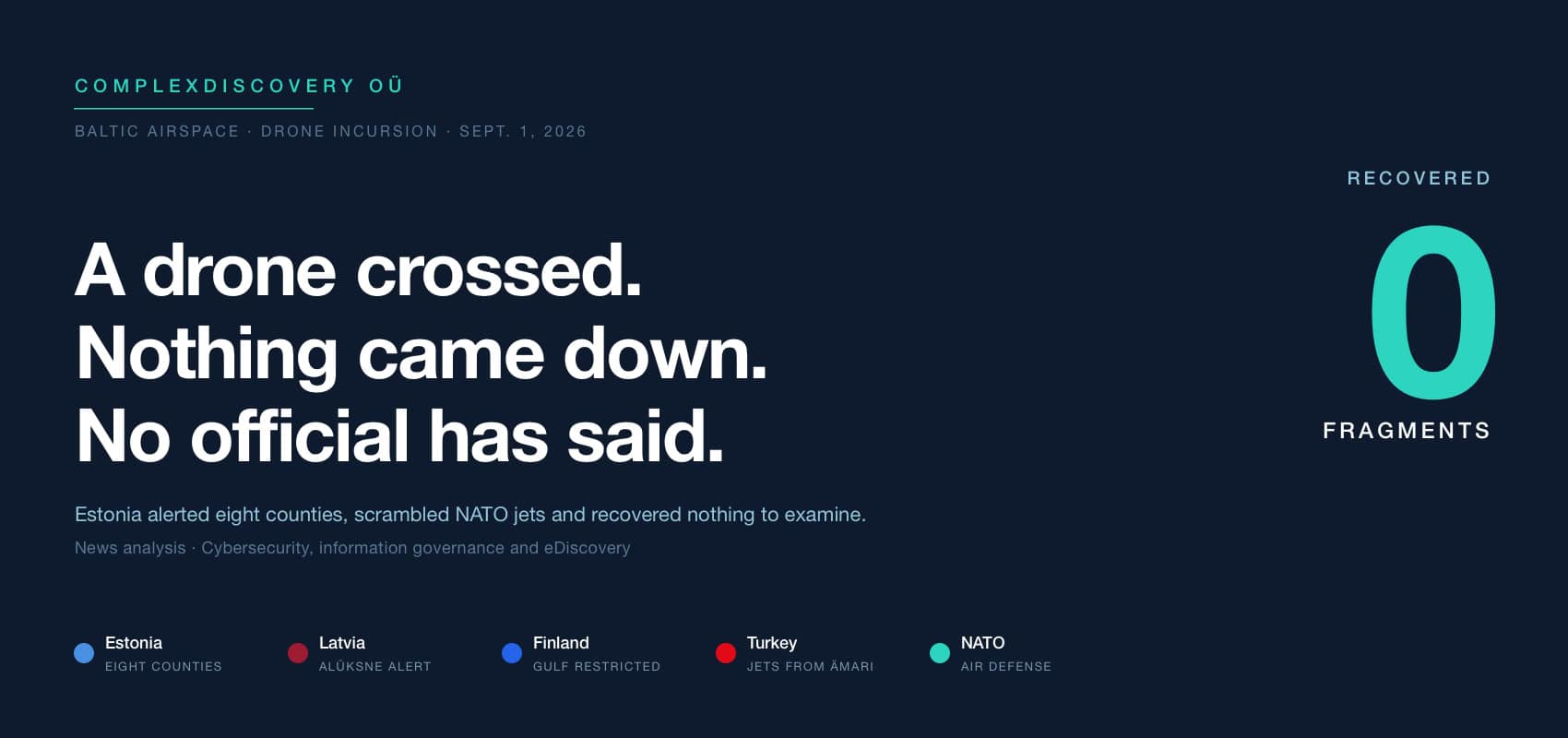
Editor’s Note: Estonia woke eight counties before dawn Tuesday, put ground air defenses on alert and scrambled NATO fighter jets, and by 5:30 a.m. it was over. One drone had crossed the southeastern border. Nothing fell, nobody fired, and no Estonian official has said whose aircraft it was.
That last fact is where this story earns the attention of people who work in evidence. Estonia has taken one of these to a conclusion, on a drone that came down in a Tartu County field in August 2025. The Internal Security Service had wreckage, explosive residue and a course traced from what the evidence would carry. It concluded the evidence indicated a drone of Ukrainian origin. It could not determine whose actions caused it to end up there, and prosecutors closed the case because going further required legal assistance from a jurisdiction where that cooperation is not functioning. Origin and responsibility turned out to be separate findings that fail separately.
Cybersecurity, information governance and eDiscovery readers will recognize the whole shape: evidence that sits beyond a functioning request channel, and a record built from what you can independently observe. Watch what allied governments decide counts as proof, because the standard they settle on will be tested again.
Content Assessment: Estonia scrambled jets over a drone no official has identified
Information - 94%
Insight - 94%
Relevance - 90%
Objectivity - 93%
Authority - 92%
93%
Excellent
A short percentage-based assessment of the qualitative benefit expressed as a percentage of positive reception of the recent article from ComplexDiscovery OÜ titled, "Estonia scrambled jets over a drone no official has identified."
News Analysis – Geopolitics Beat
Estonia scrambled jets over a drone no official has identified
ComplexDiscovery Staff
Estonia alerted eight counties before dawn Tuesday and scrambled NATO jets as one drone neared its border, then watched a second cross, lifting the warning at 5:30 a.m. without saying whose they were. Nothing came down on Estonian soil, so there is nothing to take apart, and that absence is the entire story for anyone whose work depends on proving what happened.
The sequence moved fast. Air Force Commander Brig. Gen. Riivo Valge said it became clear around 2 a.m. that Ukraine was striking targets in western Russia. About a dozen drones were visible near the border. An hour later one of them turned toward Narva, and Estonia warned residents of Ida-Viru and Lääne-Viru counties. That drone never entered Estonian airspace and veered back toward Russia. Half an hour later a second drone did cross, staying near the border zone, and the Estonian Defense Forces widened the alert to six southern counties: Tartu, Jõgeva, Viljandi, Valga, Võru and Põlva.
Turkish jets, Estonian sirens, no debris
The scramble came on the first drone, not the second. Ground air defense units went to work first, Valge said. Turkish Air Force fighter jets flying NATO’s Baltic air defense mission left Ämari Air Base immediately afterward, while the aircraft that prompted them was still tracking toward Narva. Col. Uku Arold, the Defense Forces’ head of strategic communications, told ERR that drones had run parallel to the eastern borders of Estonia and Latvia and entered Estonian territory. Valge’s account was more granular, separating the aircraft that turned back from the one that crossed. Latvia issued its own alert in the Alūksne district. In the eastern Gulf of Finland, Finnish forces put limits on shipping and flights, and Taavi Laasik of the Defense Forces press office confirmed the all-clear at 5:58 a.m.
Valge’s summary of the outcome is the sentence to sit with. “Fortunately for us, the drones did not fall in Estonia, the aircraft did not open fire, so we don’t have a missile lying around somewhere either,” he said. Read as relief, that is entirely reasonable. Read as evidence, it says the incident produced no artifact, and an incident without an artifact gets argued about rather than established.
Across the border that night, Leningrad Oblast Governor Alexander Drozdenko put the tally at 38 drones downed over his region, with damage acknowledged at the Port of Ust-Luga. The oblast had been absorbing this for days. The Institute for the Study of War recorded a Ukrainian strike on the Kirishi refinery there on Aug. 30, which a source tied to the plant said forced a partial suspension of operations. ISW has logged repeated strikes on that refinery since March 2025.
Foreign Minister Margus Tsahkna wrote on X that “NATO reacted swiftly and exactly as planned.” He called incidents like this one “a direct consequence of Russia’s war of aggression against Ukraine.” Notice what that does not do. It assigns a cause to the war, which is a defensible thing for a foreign minister to say. It does not say whose drone crossed into Estonia, and in the reporting reviewed here, no Estonian official had said so by midday Tuesday in Tallinn. Valge placed Ukrainian strikes over western Russia that night, which is a description of the traffic and not an identification of the aircraft that came across.
Where a completed investigation actually ended
Estonia has been here before with far better material. On Aug. 24, 2025, a drone came down in a field in Tartu County, the first foreign drone ever found on Estonian territory. The Internal Security Service opened a criminal investigation and worked it the way any serious forensic matter gets worked, pursuing the route only as far as the evidence would carry it. Investigators drew on expert examination of the debris, and on recordings that residents shared of the drone’s flight sounds and the explosion. That examination turned up residue from the kind of explosives attack drones carry, on pieces of the wreckage. The evidence indicated the drone had likely entered Latvia from Russian airspace, on a straight course that reached Estonia at about 4:45 a.m.
Investigators concluded that the collected evidence indicated a drone of Ukrainian origin, and found no sign that Estonia had been a deliberate target. Then they hit the wall. It was not possible to establish the drone’s exact route, or whose actions had caused it to end up on Estonian territory. The Office of the Prosecutor General signed off, and the case closed in December 2025, about four months after the drone came down in the field. State Prosecutor Triinu Olev-Aas explained why in terms any litigator will recognize. Every investigative step then available had been taken, further evidence collection would require a legal assistance request to Russia, and that cooperation is not functioning. The file was complete on its own terms and short of the answer it was opened to find. She said the proceedings can be renewed if new evidence emerges.
That case was not the last time material reached Estonian ground. Drone parts turned up in a Tartu County field again on March 31, 2026, which ERR reported was the second find in that county within a year and the third on Estonian territory.
Origin and responsibility are separate questions
The closed case is the ceiling, and it is worth being exact about where the ceiling sits. With wreckage in hand, explosive residue on the fragments and a likely route, Estonia could say what the evidence indicated about the airframe’s origin. It could not determine whose actions caused it to end up on Estonian territory. Those are two different findings and they fail independently. The second failed for a reason the laboratory bench could not reach, because further evidence collection required a legal assistance request to Russia through a channel that was not functioning.
Estonia’s crisis-communication service drew the same line in May. A Romanian F-16 flying the Baltic Air Policing mission shot down a drone over central Estonia at 12:14 p.m., and debris fell between Lake Võrtsjärv and Põltsamaa. The government notice called the aircraft probably of Ukrainian origin and said it had entered from the direction of Russia. It did not identify who was responsible. Defense Minister Hanno Pevkur later said only allied aircraft had Estonia’s permission to fly there, and that Ukraine’s defense minister apologized for the incident.
Practitioners who handle cross-border matters will recognize this shape. The needed evidence lay beyond a functioning request channel, so the file stopped where the accessible record stopped. What remains is whatever the requesting party can independently observe. Estonian investigators responded by stating the finding the evidence supported and marking plainly where the observable record ended, rather than reasoning across the gap toward a conclusion the file could not carry.
Jamming that reaches across the border
The environment producing these crossings is not mysterious, and Estonians have described it publicly. Tallinn University of Technology senior lecturer Ivo Müürsepp told ERR in May that two technologies get collapsed into the single phrase “GPS interference.” Jamming, he said, “essentially means shouting over the real signal.” Spoofing is subtler, and in a military setting it is the more troublesome of the two. The receiver keeps a signal but is fed a false location, so the aircraft flies an unintended course while behaving, from its own point of view, correctly.
Müürsepp described a network of smaller jammers rather than one large emitter. Each covers a radius of about 25 kilometers, and they are reportedly installed in places such as mobile communications towers to protect Russian strategic sites from drone attack. Reporting from commercial aircraft shows the effect. Data current as of May 2026 put the areas around Estonia and Finland and the Kaliningrad region in the red band on public interference maps. Red marks zones where over 10 percent of aircraft passing through in the previous 24 hours detected interference.
What nobody has established is intent. Defense News reported in March, after all three Baltic states logged incursions inside roughly 48 hours, that whether Moscow steers these drones toward NATO territory on purpose remains unresolved. The crossings may instead fall out of electronic warfare defending Russian sites, and Western officials have so far treated them as accidents. Estonian Defense Forces Commander Lt. Gen. Andrus Merilo has explained why the drones often go unengaged. “Our goal is to avoid any unintended escalation, so we certainly cannot engage drones where there is even the slightest risk that our actions could carry over into Russian territory,” Merilo said in remarks reported by Defense News. The drone downed in May had already reached central Estonia, well clear of that constraint.
The pattern is regional rather than Estonian. ERR reported last month, citing The Times, that at least 10 drones have entered Latvian, Estonian, Lithuanian and Finnish airspace since March, as Ukraine intensified long-range strikes around St. Petersburg. Poland and Lithuania have warned that Moscow could stockpile downed Ukrainian drones for a false-flag operation against a member state. Tsahkna told the paper that such scenarios deserve to be taken seriously, without allies amplifying every hypothetical on Moscow’s behalf. What matters, he argued, is that NATO can establish the facts quickly, because Russia’s aim is to create confusion about who is responsible and make allies hesitate.
The alliance machinery has a higher gear, and it was used twice in September 2025. Poland requested Article 4 consultations that month after Russian drones crossed its border, and Estonia requested them after three Russian fighter jets flew into its airspace. Defense News reported that none of the three Baltic governments signaled an intent to invoke Article 4 or Article 5 over the March 2026 cluster.
Fragments of one picture, held in four places
Establishing facts quickly turns out to be a records problem before it is a sensor problem. Eva Sula, an Estonian defense strategy adviser who works on military systems integration, told ERR that no technological wall on the eastern border resolves this. Every counter-drone system carries its own limits, and the layers have to be tied together deliberately. Her sharper point was about who holds what. A radar in Estonia, a sensor in Latvia, an aircraft under NATO command and the civilian agencies responsible for critical infrastructure may each hold a different fragment of the same picture, she said. Fragments that cannot be exchanged fast enough will defeat even excellent individual sensors.
Anyone who has run a multi-party investigation knows that shape. Mārtiņš Vargulis, a former senior Latvian defense ministry official who now lectures at Rīga Stradiņš University, has put a clock on the consequence. Attributing one of these incidents demands thorough analysis that can take several days. Governments face domestic pressure to respond during exactly that window to something they cannot yet name. He asked readers to imagine a diverted drone hitting a school or an energy facility and killing civilians while investigators are still working out whether the airframe was Russian or Ukrainian, and whether it had been electronically manipulated. Ambiguity of that kind, he said, makes escalation far harder to manage.
What the record teaches about contested evidence
Three habits follow for anyone building a record under these conditions. Preserve your own telemetry immediately and completely. When the counterparty’s records are unreachable, your independently generated data stops being corroboration and becomes the entire evidentiary base. Write the interference environment into the record as a condition affecting data quality, the way Estonian investigators traced a course without claiming it settled the drone’s exact route. And keep origin separate from responsibility in the language of your own findings. A write-up that blurs them will be read as claiming the stronger one, and the stronger one is usually the claim you cannot support.
Müürsepp’s closing point deserves the last word on method. No defense reaches complete protection, he said, and some residual risk always stays, the same way it does with cyberattacks or air defense. Aviation, defense and critical infrastructure now have to assume satellite navigation may fail them, and build the fallbacks in as routine rather than exceptional. Planning for a degraded signal is now ordinary engineering advice. Planning for a degraded evidentiary record is that same advice pointed at a different problem, and it rarely gets stated in those terms even by organizations that already accept the first half.
Estonia’s alerts went out, the jets flew, and the warning lifted inside three hours. Tsahkna called NATO’s reaction swift and exactly as planned, and he is also an interested party. NATO moved its Baltic mission from air policing to air defense on Aug. 1, a month before Tuesday’s scramble. The new mission adds a more operational active-defense capability. That changes the available response capability, not what Estonia can establish afterward, and Tuesday produced a scramble, an all-clear and nothing at all that anybody could take to a laboratory bench.

News sources
- Drone crossed Estonia’s border in southeast, says air force commander (ERR News)
- EDF: Drone threat warning lifted across Estonia (ERR News)
- Crashed drone in Tartu County: Investigation finds no evidence Estonia was a target (ERR News)
- GPS interference across the Baltic region is eroding satellite navigation reliability (ERR News)
- The Times: Venemaa lõikab kasu droonide sattumisest NATO õhuruumi (ERR, relaying The Times)
- A NATO jet shoots down a suspected Ukrainian drone over Estonia (Estonian World)
- Ukrainian drones hit all three Baltic States, did Russia redirect them? (Defense News)
- A Romanian fighter jet shot down a drone that had strayed into Estonian airspace (kriis.ee, Estonian Government Communication Unit)
- Turkish Air Force took over the NATO Baltic air defence mission in Estonian airspace (Estonian Defence Forces)
- Turkish F-16 fighters scramble after drones cross into Estonia’s airspace (Aerotime)
- Ukrainian drones damage Russia’s Ust-Luga port, governor says (The Kyiv Independent)
- Russian Offensive Campaign Assessment, August 31, 2026 (Institute for the Study of War)
- Russian Offensive Campaign Assessment, August 30, 2026 (Institute for the Study of War)
- Russian Offensive Campaign Assessment, August 29, 2026 (Institute for the Study of War)

Assisted by GAI and LLM Technologies
Additional reading
- Russia leans on drones and dissent-proofing as fuel crisis bites
- Senate passes Graham sanctions act, shifting Russia pressure from policy to statute
- Lithuania’s false-flag warning puts drone attribution on NATO’s eastern flank
- Three accounts from one wartime morning in Russia
- When an air defense engagement becomes a criminal case file
- The week the war reached Russia’s e-commerce supply chain
- The three silent hours: How Russia’s cyber war targets Ukraine’s newsrooms
- Confirmed versus claimed: reading the gap in Russia’s June offensive
- When the flag may be fake: Ukraine’s June war and the new burden of proof
- When the drone war reaches the reactor fence: Ukraine and the cyber-physical front
- When the refineries burn: Ukraine’s strikes turn Russia’s energy backbone into a cautionary tale
- The night Ukrainian drones exposed gaps in Moscow’s defenses and state TV gave it 60 seconds
- From warning to funding: Russia’s expanding media machine and the risk signals ahead
- Invisible by design: NATO’s 2026 cognitive warfare paper and the crisis of discovery
- When Your Legal Tech Vendor Gets Breached: DocketWise Incident Exposes 116,666 Immigration Records and a Profession’s Blind Spot
- The DOJ’s Cyber FCA Playbook Is Working as Enforcement Triples and Shows No Signs of Slowing
- FTC’s OkCupid Action Reframes AI Training Data as a Consumer Protection Issue
- White House AI Framework Signals New Compliance Stakes for Legal, Cybersecurity, and eDiscovery
- The Gatekeeper’s Key: How the Conformity Assessment Unlocks the EU AI Market
Source: ComplexDiscovery OÜ

ComplexDiscovery’s mission is to enable clarity for complex decisions by providing independent, data‑driven reporting, research, and commentary that make digital risk, legal technology, and regulatory change more legible for practitioners, policymakers, and business leaders.