

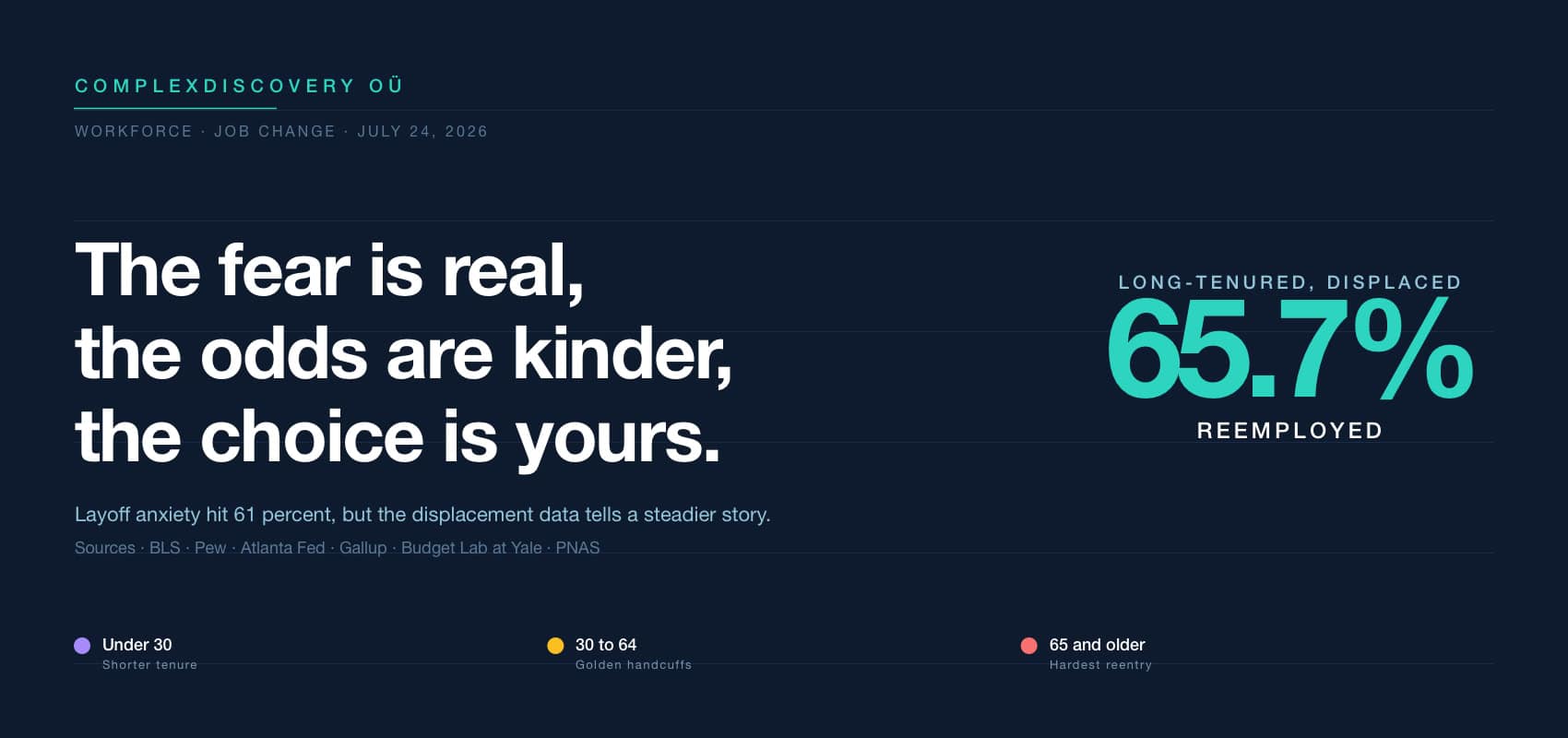
Editor’s Note: Layoff anxiety now reaches a majority of American workers, yet the federal data on people who lost long-held jobs is more mixed than the mood. The Bureau of Labor Statistics displacement survey, conducted every two years and still the most recent available, measured how workers displaced during 2021 through 2023 stood as of January 2024: 65.7 percent were employed again, 34.3 percent were unemployed or outside the labor force, and some who found new work took a pay cut. Anxiety measures how people feel; the displacement data measures what happens, and the two rarely line up.
The stakes land close to home in cybersecurity, data privacy, regulatory compliance and eDiscovery, credential-heavy fields marked by vendor consolidation and steady automation pressure, where a disengaged or departing employee is a retention question and, at times, an insider-risk and data-governance one. Those who manage information for a living carry the same career risk as everyone else.
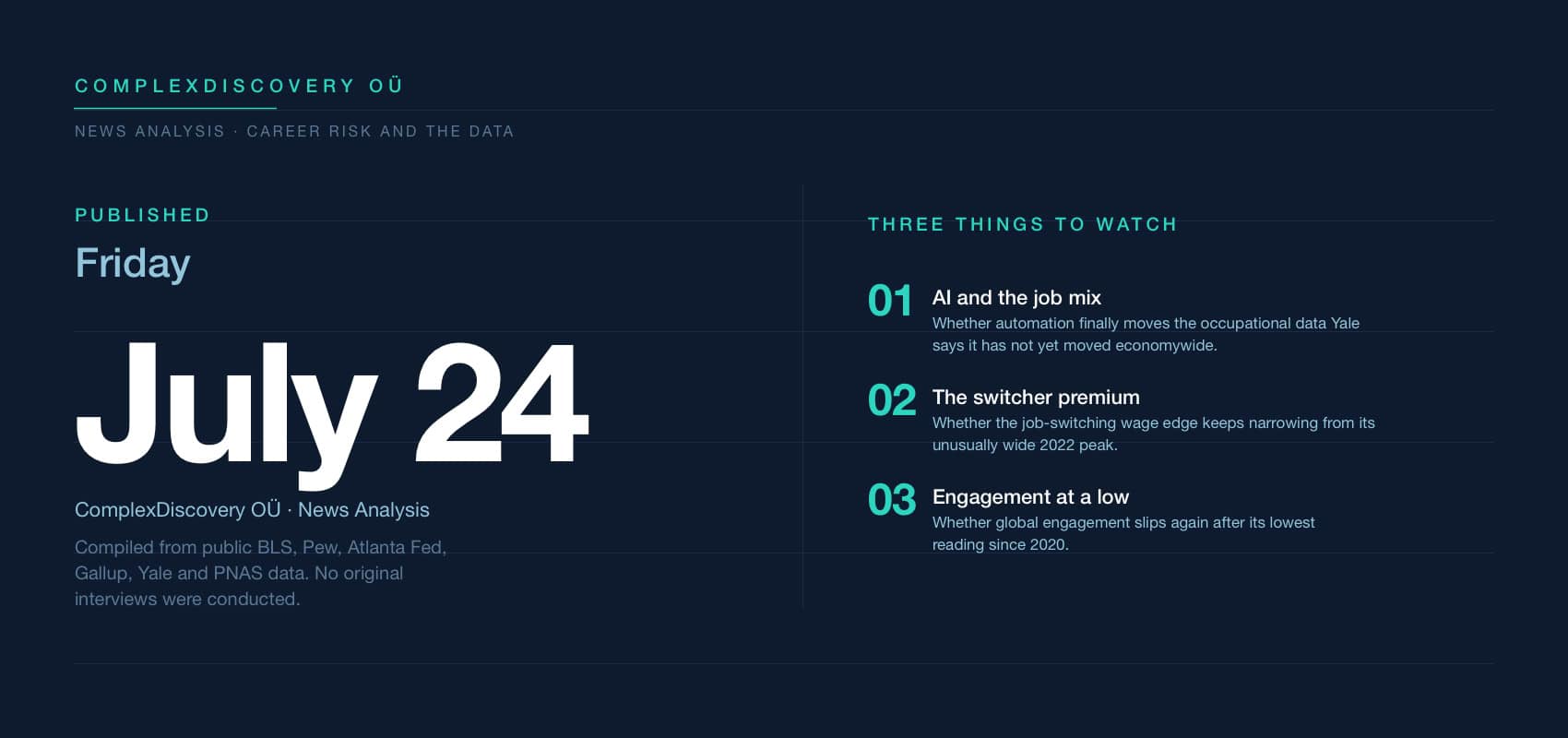
Watch three signals into 2027: whether AI moves the occupational-composition needle the Budget Lab at Yale says it has not yet moved economywide, whether the switcher wage premium keeps narrowing, and whether global engagement slips below its lowest reading since 2020. Each shifts the stay-or-go math.
Content Assessment: The fear before the layoff: what the research says about job change, and what it costs
Information - 92%
Insight - 93%
Relevance - 88%
Objectivity - 90%
Authority - 91%
91%
Excellent
A short percentage-based assessment of the qualitative benefit expressed as a percentage of positive reception of the recent article from ComplexDiscovery OÜ titled, "The fear before the layoff: what the research says about job change, and what it costs."
Industry News – Leadership Beat
The fear before the layoff: what the research says about job change, and what it costs
Sentiment and outcomes: what the job-change data can and cannot say
ComplexDiscovery Staff
The fear arrives before the layoff does. Long before a manager schedules the meeting, many workers rehearse the worst case, and that rehearsal has become a familiar feature of working life.
In INTOO’s 2025 Employee Mindset Report, produced with The Harris Poll, 61 percent of employed Americans reported layoff anxiety, compared with 48 percent in INTOO’s 2019 study. INTOO is an outplacement firm that sells career-transition services, so the finding is vendor-commissioned; the same survey found 52 percent would accept a pay cut for a job they believed was layoff-proof for two years. Anxiety now carries a price people say they are willing to pay.
The harder question is whether that fear tracks reality, and the available data cannot answer it directly, because surveys of anxiety and studies of displaced-worker outcomes measure different populations and different questions. What the outcome data does show is that losing a long-held job often ends in reemployment, while still leaving a sizable share jobless, outside the labor force or earning less. A person can reasonably fear even a low-probability event when its financial consequences are severe.
What the displacement data actually shows
Start with what happens after a job actually disappears. The U.S. Bureau of Labor Statistics (BLS), in its most recent Worker Displacement Summary, a survey conducted every two years and released Aug. 29, 2024, counted 2.6 million long-tenured workers, those with at least three years on the job, displaced during the 2021 through 2023 calendar years. As of the January 2024 survey, 65.7 percent of them were employed, 16.1 percent were unemployed and 18.2 percent had left the labor force. Among the narrower subset who moved from one full-time wage-and-salary job to another and reported prior earnings, 62 percent were earning at least as much as in the job they lost.
Read those figures for what they are. The 65.7 percent is a single-month snapshot, not proof that everyone found work quickly; the workers in the count had been displaced anywhere from about a month to three years before the survey. The 62 percent earnings result covers only full-time-to-full-time movers who reported prior pay, and “at least as much” refers to reported earnings; the BLS release does not present an inflation-adjusted comparison or measure restored benefits, seniority, savings or retirement security. The picture that emerges is a genuine split: displacement frequently ends in reemployment, yet it leaves a substantial minority unemployed, out of the labor force or earning less. That is more sober than either pure dread or easy reassurance. The conventional guidance from career counselors, keep an updated record of accomplishments and a living professional network before either is needed, does not change these base rates, but it can make a search less chaotic once one starts.
Switchers still see faster wage growth
For those weighing a move by choice, the wage data has shifted. The Atlanta Fed’s Wage Growth Tracker, which follows median 12-month wage growth among matched workers, put the overall figure at 3.6 percent in June 2026. Job switchers continued to record faster median wage growth, at 4.1 percent, than stayers, at 3.4 percent, though the gap was narrower than during the unusually active labor market of 2022. The tracker does not establish that switching caused the difference, and its switcher category folds together changes of employer, occupation, industry and job duties. Read as a correlation rather than a lever, it still argues for negotiating hard where you are before assuming the exit is the upgrade.
Under 30: shorter tenure, lower satisfaction
Consider, hypothetically, a 27-year-old analyst two years into a compliance role, watching headlines about automation and wondering whether the career is already obsolete. Pew Research Center found in December 2024 that 43 percent of workers under 30 were extremely or very satisfied with their jobs, the lowest share of any age group. Younger workers generally have shorter tenure and are more likely than older workers to have been with their current employer for a year or less. As for the automation fear itself, the reassurance is partial but real: the Budget Lab at Yale reported no substantial economywide acceleration in the rate of change of the labor market’s occupational composition since ChatGPT’s release. The same researchers flagged a modest recent divergence between newer and older graduates that might reflect AI or simply a slower labor market, on a sample small enough that they called the finding preliminary. For this group, the move is to compound skills and tenure, not to panic-hop on every rumor.
The 30-to-64 middle and its golden handcuffs
Consider a hypothetical 45-year-old marketing director with a mortgage and two children. Satisfaction rises through these years, 48 percent for workers 30 to 49 and 56 percent for those 50 to 64 in the Pew data, but so does exposure: salary, equity and benefits that make staying rational even when the work grinds, and dependents who feel any disruption. This is the stretch where the compromise question gets most concrete, because the cost of walking away is measured in things other people rely on. A defensible posture is to keep options warm without acting on them, treating occasional interviews as market research and a resume as a document that never goes fully cold. The “golden handcuffs” label is a reading of that squeeze, not a survey category; the Pew numbers measure satisfaction, not the household obligations that tighten the grip.
At 65 and older: highest satisfaction, lowest measured reemployment
Here the satisfaction numbers invert. Pew found 67 percent of workers 65 and older were extremely or very satisfied, the highest of any age group. The reentry math, though, is harder. In the BLS displacement data, 55.3 percent of long-tenured displaced workers ages 55 to 64 and 34.4 percent of those 65 and older were employed in January 2024, compared with 74.5 percent of those ages 25 to 54. But 52.5 percent of the 65-and-older group was outside the labor force when surveyed, so the figures do not distinguish unsuccessful reentry from retirement decisions. A separate 2018 Urban Institute study, which followed 2,086 workers who held long-term full-time jobs at ages 51 to 54 and tracked them past 65 using data from 1992 to 2016, found 56 percent later went through a financially consequential, employer-related involuntary separation, a category that spanned layoffs and business closures as well as dissatisfaction-driven quits and unexpected retirements. Among those who experienced such a separation, median household income fell 42 percent. For workers in this cohort, that asymmetry, high satisfaction paired with a slower and less complete recovery if the job ends, argues for protecting the current role, documenting one’s value and phasing retirement deliberately rather than testing the open market casually.
When the paycheck asks for a compromise
This is where satisfaction, relevance and compensation collide. Gallup’s State of the Global Workplace report, published April 7, 2026, put global employee engagement at 20 percent for 2025, down from 21 percent and the lowest reading since 2020. Gallup estimated that low engagement cost the world economy about $10 trillion, or 9 percent of GDP, in lost productivity, a figure the firm models rather than measures directly. Jim Harter, chief scientist for workplace and well-being at Gallup and a lead author of the report, has said a decline in manager engagement accounted for much of the downturn since 2023.
Underneath the engagement numbers sits an uncomfortable pattern: many people stay in jobs that ask them to do things they would not choose. They sell products they find mediocre, enforce policies they doubt, chase metrics they think are hollow, because the paycheck clears a threshold that matters to them. On that threshold, the research is careful. In a 2023 adversarial collaboration published in the Proceedings of the National Academy of Sciences, Matthew Killingsworth of the Wharton School, the late Daniel Kahneman and Barbara Mellers reconciled earlier, opposing findings. For most participants, higher income was associated with higher emotional well-being, including above $100,000 a year. Among the least-happy group, that association flattened at about that level. The study measured an association, not a purchase, and it did not test whether added compensation can offset dissatisfaction with a particular job.
Higher pay tracks higher well-being for most people. It is not, on this evidence, a remedy for a job someone dislikes. Beyond that point the evidence runs out and judgment takes over. Compensation is neither a trap nor a virtue; it is a variable. The worker who knows their own threshold, the number below which resentment sets in and above which a compromise is tolerable, negotiates from a clearer position. The worker who has never run that math tends to do one of two things, leave too early or stay too long, and both are costly.
So the synthesis across every age is similar. Weigh the fear against the base rates rather than against the headlines. Know the range of displacement outcomes, treat the switching premium as a correlation and not a promise, and price your own compromise honestly before an employer, a downturn or an algorithm prices it for you.
What is your number, the point where satisfaction, relevance and compensation stop balancing and something finally has to give?
News sources
- Worker Displacement: 2021-23 (U.S. Bureau of Labor Statistics)
- Americans’ job satisfaction in 2024 (Pew Research Center)
- Wage Growth Tracker (Federal Reserve Bank of Atlanta)
- Global Employee Engagement Continues Decline (Gallup)
- Evaluating the Impact of AI on the Labor Market: Current State of Affairs (The Budget Lab at Yale)
- How Secure Is Employment at Older Ages? (Urban Institute)
- Income and emotional well-being: A conflict resolved (Proceedings of the National Academy of Sciences)
- Employee Tenure Summary (U.S. Bureau of Labor Statistics)
- Careers Become Dicey After Age 50 (Center for Retirement Research at Boston College)
- How Layoff Anxiety Has Changed Over Time (INTOO and The Harris Poll)

Assisted by GAI and LLM Technologies
Additional reading
- The conversation that is never about work-life balance
- One hexagon, three industries, two feet: a brand lesson in sneakers
- The Planning Paradox: an Oxford-style tutorial tests why business plans fail
- An Oxford tutorial for newsroom leaders who must learn faster than the news
- An Oxford tutorial for cybersecurity, governance and eDiscovery
- Estonia aims to be first to give AI agents official digital IDs
- Parliament hits pause on high-risk AI rules and bans nudifier apps
- Europe’s AI labeling rules arrive with a voluntary code and a hard deadline
- AI is becoming an advisor, and it is rewriting how buyers find you
- What marketing confidence actually looks like
- When credibility comes first, capability sells itself: The case for news-led marketing
- The one question that reveals whether your marketing plan is actually a plan
- How Prompt Marketing Is Redefining Thought Leadership In The AI Era
- Raising The Age Ceiling: How AI Is Extending Executive Leadership
- Staying Curious: One Practical Defense Against Creative Burnout
- From Longbows To AI: Lessons In Embracing Technology
- 20 Ways Creative Professionals Battle Burnout And Find Fresh Ideas
- 14 Points For Brands To Consider Before Making Sociopolitical Statements
Source: ComplexDiscovery OÜ

ComplexDiscovery’s mission is to enable clarity for complex decisions by providing independent, data‑driven reporting, research, and commentary that make digital risk, legal technology, and regulatory change more legible for practitioners, policymakers, and business leaders.